What a whirlwind of a primary. I’ve had an interesting perspective in this primary since my candidate, Herman Cain, left the race because I don’t really support any of the four current candidates. I find all four have certain qualities that make them interesting possibilities, and all four have flaws that rule them out for obtaining my full personal support. So for the first time in my voting lifetime, I don’t have a dog in the fight. I’m in a curious “watch and see” mode that is proving to be highly entertaining as this thing rolls out.
Which brings us to the question… how’s this thing rolling out?
If there is anything we’ve learned about the 2012 GOP primary, it’s that it simply cannot be predicted. Well, certain parts can, but the overall picture cannot. I’ve made two big predictions in this primary. My first was that Sarah Palin would endorse Rick Perry (they were chums as Governors and Perry strongly supported her). Obviously Perry floundered and dropped out, so that didn’t happen. My second prediction was that Romney would win Florida by a landslide. That did happen. And for the exact reasons I predicted it would.
My view of what I thought would play out in February went blurry on February 7th. Yes, to be clear, the three states that held primary elections on February 7th meant nothing in terms of binding delegates. Ron Paul and Newt Gingrich fans like to constantly point that out. But in doing so they ignore the importance of perception in politics. For many voters (and by many I mean a LOT) perception is reality. Donation and word of mouth support begins taking hold based on perception. If a candidate is perceived as having a shot at coming out in front, that individual will see a significant increase in fundraising and support.
I knew Romney wouldn’t win Missouri. The state is far too conservative for his style of politics and it outright rejected Romney in every single county. Where I got thrown off is Minnesota and Colorado.
Minnesota should have at least been competitive for Romney. During the Florida primary Minnesota looked decent for a Romney win or very strong second. Former Minnesota Governor Tim Pawlenty was working the Romney brand and the Romney campaign was financially positioned to be well organized. In the end Mitt Romney pulled 17% of the vote for a distant third place finish. And I mean very distant. It would be an understatement to say Romney wasn’t competitive in Minnesota. The accurate statement would be that he didn’t even compete.
Colorado should have been safe territory for Romney. Mitt Romney dominated Colorado back in 2008 and should have walked away with an easy win. Instead, Romney lost to Santorum in a stunning last minute shift in some rural Colorado counties. My best guess for this is the Romney camp took Colorado for granted. They knew there were no delegates up for grabs and figured they were well positioned for a win there that would have dislodged any energy gained elsewhere.
The Colorado loss was a devastating miscalculation. Which brings us to the current scenario and possibilities as to how the rest of February might play out.
First, let’s look at the national polling trend.
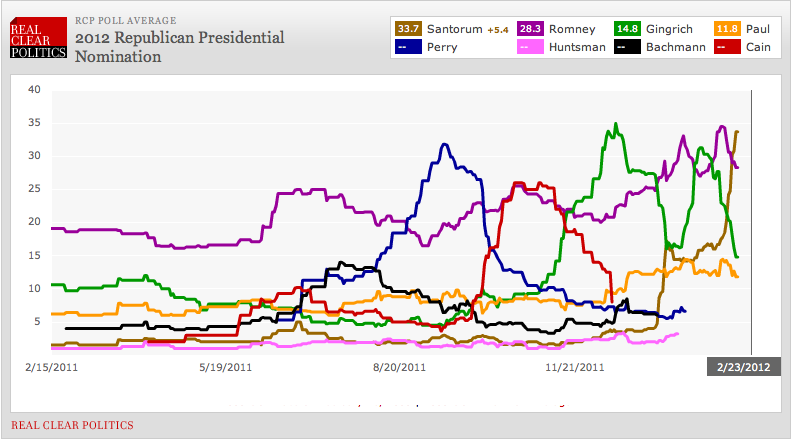
Rick Santorum now finds himself as the national front-runner with a 5.4% advantage over Mitt Romney. Newt Gingrich is at his lowest average since mid-November, coming in with just under 15%. Ron Paul sits at the usual 12%.
On February 28th we’ll see primary elections in Michigan and Arizona. Mitt Romney was expected to win both, but is now slipping to a second place position in the trends in Michigan. He still holds well in Arizona, which is important for his campaign since Arizona is a winner-takes all state on the delegates. If Rick Santorum wins Michigan and Mitt Romney wins Arizona, Romney would be ahead in terms of binding delegates, but both would have a 50/50 shot at the nomination.
On Super Tuesday Mitt Romney is likely to take Massachusetts, Vermont and Virginia. Newt Gingrich will get a big delegate boost out of Georgia (although his lead in Georgia slipped from 53% in December to just 9% now). Rick Santorum is positioned well in Ohio, but Romney’s media machine could very well change that. Santorum will compete with Gingrich for Tennessee, Oklahoma, Idaho and Alaska.
In other words, in a situation where Romney’s camp would have liked to have the deal sealed by Super Tuesday at the latest, we might find ourselves exactly where we are now, a day after Super Tuesday. A tied up front-runner spot with Romney struggling to stay out front.
In all honesty, I don’t see how Romney wins the primary if Gingrich or Santorum drop out. More so if Gingrich drops out, as Santorum appears to be a more acceptable candidate for general consensus within conservative ranks.
But again, anything can happen and there is no way to predict this. I guess the most important take-away here is that Romney is no longer the clear front-runner and may end up losing the primary yet again. Four weeks ago that didn’t at all seem possible.
-Eric Odom