Pennsylvania and New Mexico Trending Toward Obama

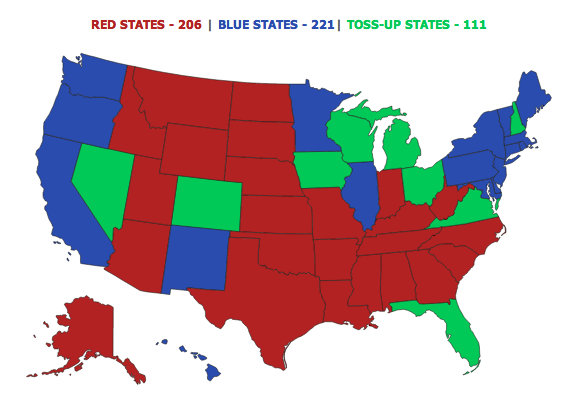
Each week we take a deep look at our 2012 Election Ratings Maps and re-evaluate the ratings accordingly. We recently shifted Missouri and North Carolina safely to red, with New Hampshire shifting to Toss-Up. Today we regret to publish our latest map with two states moving from toss-up to blue.

Pennsylvania and New Mexico.


The new projection map shifts Obama in to the lead in terms of electoral votes, coming in at 221 vs. 206 for Republicans. 111 electoral votes are up for grabs and 270 are needed to win.

Why Pennsylvania and New Mexico? Our ratings system includes a mix of historical data, current ground operations and campaign infrastructure, voter approval and broad poll averages. In New Mexico it appears as though the Romney camp is non-existent. Sure, there may be official presence, but it’s not the kind of presence you would see in a competitive state. To make matters worse, the latest Rasmussen Report poll shows Obama up by a whopping margin of 14%! The RCP average shows 10%.

Pennsylvania doesn’t perform much better. The current average is at 7.7%, but the latest polls suggest a margin of up to 9%. Romney is very active in Pennsylvania, but Obama is putting enormous resources into the state and there are no signs PA will give Romney a chance.

This is just a projection based on the data available today. The race is very fluid and could certainly change as the final stretch heats up, but right now it looks as though Pennsylvania and New Mexico are safe for Obama.

Which makes Romney’s path to victory extraordinarily difficult, but doable.


GOP May Gain Senate Seat in… Connecticut?

RACE RATING  CHANGE FOR CONNECTICUT: RACE NOW TOSS-UP

Just after writing about changes in the Ohio race I began sifting through emails from a friend in Connecticut that were quite interesting. I’ve been so fixated on Missouri, Nevada and Ohio that I’ve completely overlooked Connecticut. As it turns out, Connecticut is now wide open for an epic GOP upset.

This is not just a matter of solid organization on the ground and a good Republican candidate with plenty of name ID. Even the average polling data is backing it up. Via Real Clear Politics polling average for Connecticut.

Democrat Chris Murphy enjoyed an 11% lead in June. That lead has been crunched down to less than a full 1% and Republican Linda McMahon even polled 3% up in the last two major polls conducted in Connecticut.

What’s the weakness for Democrats? Chris Murphy is a sitting Congressman with a voting record that isn’t one to be proud of in this current political environment. Murphy is part of the Washington establishment and he can’t deny his alliance with faulty liberal policy.

McMahon, on the other hand, is a business woman who isn’t associated with Washington or the Obama/liberal agenda.

With Akin in trouble in Missouri, Republicans have some work to do. A possible win in Ohio and Connecticut are huge for gains in the Senate.

We’ll keep an eye on this and let you know of any changes moving forward.


Gallup: 60% of Adults Disapprove of Obama’s Handling of Economy

The only question is, what are the other 40% smoking:

Three months before the election, President Barack Obama gets good marks from Americans for his handling of terrorism, fair marks for education and foreign affairs, but poor marks on immigration and three big economic issues: the federal budget deficit, creating jobs, and the economy generally.

President Barack Obama Approval on Issues

Obama’s handling of the economy has been a miserable failure. How 40% of the population can see anything but that is astonishing.

Remember, 2010 was supposed to be the Summer of Recovery. Republicans were unable to stop anything the Democrats wanted to do.

Here we sit at over 8% unemployment still. How does anyone approve of this?

Can anyone help me understand this?

Is North Carolina Really in Play?

Joe Biden recently told a crowd in Virginia that Democrats can win North Carolina. Apparently he thought he was in North Carolina, or maybe he thought Virginians can help the Dems with their North Carolina problem? Who knows… Joe Biden is a tough one to figure out. But it did get me thinking about North Carolina.

I’ve heard a few pundits claim North Carolina is up for grabs. I haven’t really seen any data to support this and the typical back up to the claim is that North Carolina went to Obama last time around. I find it astonishing this is the only real piece of evidence to point to in making such a claim, so I began digging for further evidence.

In short, there is none. In fact, to the contrary, I believe North Carolina will give Mitt Romney a landslide victory across the state.

For starters, we were one of the first to switch North Carolina from “toss up” to the Romney win column (predicting, of course). We track this on our site at VoterTeaParty.com and you can see our map on the homepage.


There are a couple pieces of the algorithm to point to in making such a prediction.

The 2008 Results

If I were a left leaning pundit I wouldn’t point at the 2008 results with much pride. Obama defeated John McCain by just 1%. Worse, Obama didn’t even gain a majority 51%, defeating McCain by just 50% to 49%.

Furthermore, 2008 was a toxic year for Republicans. A John McCain ticket was destined for failure in that political environment and while it’s surprising he couldn’t squeak out a win in even a state like North Carolina, the percentage he lost by was extremely minimal. On the other side of that coin, George Bush stomped John Kerry with 56% to 44% in 2004.

No, North Carolina is not a purple state.

Governor Race

Democrat Governor Beverly Perdue is retiring, leaving the seat wide open and up for grabs. Democrats had initially hoped to retain the seat, but Pat McCrory jumped in and changed the game. McCrory ran against Perdue in 2008 and barely lost. But the loss is attributed to the Obama machine placing so much energy into state wide organization vs McCain’s lackluster effort. McCrory is a popular former Charlotte Mayor and is highly likely to crush Democrat candidate Walter Dalton.

A recent Rasmussen poll had McCrory up by 14% pulling 49% to Dalton’s 35%.

Momentum in favor of McCrory will have heavy influence on what happens at the top of the ticket with Romney. GOTV programs, that of Romney, McCrory and the Party, will all function in unison as a machine opposing the underdog Democrats.

Polling Data

The last time Obama had an advantage in the poll average was on May 15th. At that point Romney surpassed Obama and has held an advantage ever since. Rasmussen released a state poll the first week of August that showed a 5% lead for Romney. That lead is expected to expand now that Paul Ryan is on the ticket.

So if we look at historical trends, current statewide political landscape and state based polling data, there is nothing at all that suggests Obama is positioned to retain North Carolina.


Voter Enthusiasm Quickly Shifting to Romney/Republicans

Republicans looking at battleground state polls today have reason to be concerned. Romney as an individual is not yet resonating with whoever these polling firms are calling. Where the Romney camp will find room for growth in optimism is in voter enthusiasm among those most likely to vote.

A new infographic tells the story.

Republican-leaning voting blocs are more enthusiastic to vote this November, which could be the deciding factor in a turnout election. As we head into the final campaign stretch, President Obama faces the unwelcoming reality that he must close the voter enthusiasm gap and improve his performance among key voting subgroups if he is to be successful in his bid for reelection.

When looking at those voters who say they are extremely enthusiastic to vote in the presidential election, Republicans hold a double-digit advantage over Democrats, 62 to 49 percent, and the subgroups most likely to support Governor Romney register higher enthusiasm than those backing President Obama.

Here’s the infographic. (click here for larger view)

It gets even worse for Obama when you dig deeper into the data.

In addition to the enthusiasm gap, President Obama is underperforming among key members of his coalition. He holds 53 percent support on the ballot among voters with household income less than $50k, down seven points from 2008. President Obama swept young voters (18-to-29-year-olds) by 66 to 32 percent in 2008, but this margin has been nearly cut in half, 53 to 35 percent. Typically a swing voting bloc in presidential elections, Catholic voters are clearly up for grabs, 47 to 47 percent.

Among subgroups that President Obama is likely to lose, he’s doing so by a wider margin. The president trails among white men 61 to 30 percent, a 15 point swing compared to 2008 (57 to 41 percent). His support among white non-college educated voters is also down eight points.

It will be difficult for President Obama to close these gaps by winning the undecided voters outright. Nearly every poll puts the presidential contest in a statistical dead heat, with President Obama and Governor Romney battling to win a small percentage of undecided voters. Resurgent Republic’s most recent survey found only five percent of voters nationally are undecided on the presidential ballot, while that figure shrinks to three percent in the battleground states.

This is why I believe Obama is no longer putting a major part of his effort and energy into the undecided vote. He’s now, instead, seeking to pander to his hard left base with the hopes of high liberal turnout, especially among liberal minority voters. This can work, but only if Romney fails to select the right combination in VP that will help his approval rating rise. If Romney makes the right choice and creates a marketable package, it could very well be all over for Obama.


Obama’s $190 MILLION Swing State Ad Buy

Obama has already spent some $109 million on media, a number estimated to be twice as much as Mitt Romney. Obama just dropped another $77 million for swing states ads that begin airing today.

Washington (CNN) – The Obama campaign has taken the extraordinary step of booking $77 million in additional ad time starting Friday and running through Election Day, a Republican ad buying source told CNN.

The new buy is for thirty second broadcast TV spots that will run in eight battleground states.

Through Thursday Team Obama will have spent at least $106 million in general election ads – more than twice what the Mitt Romney campaign has bought. This buy will bring his total media purchase so far this cycle to almost $190 million.

That’s three months straight of TV ads by the Obama campaign. We usually see this kind of saturation during the final six weeks, but the final three months? That seems like a ton of air time. And why has the $109 million Obama already spent not helped move his standing in the overall polls?

Obama Beginning to Tank… Romney Surging

First, let’s look at Gallup.

These are the results when registered voters are asked: “Suppose the presidential election were held today. If Barack Obama were the Democratic Party’s candidate and Mitt Romney were the Republican Party’s candidate, who would you vote for Barack Obama, the Democrat or Mitt Romney, the Republican?” Those who are undecided are further asked if they lean more toward Obama or Romney and their leanings are incorporated into the results. Each seven-day rolling average is based on telephone interviews with approximately 3,050 registered voters; Margin of error is ±2 percentage points. Results from April 15 through May 6 are based on five-day rolling averages with approximately 2,200 registered voters each; Margin of error is ±3 percentage points. Editorial note: Due to a technical issue, the May 1-5 data point is not displayed at this time.

Now Rasmussen.

The Rasmussen Reports daily Presidential Tracking Poll for Thursday shows Mitt Romney attracting 48% of the vote, while President Obama earns support from 44%. Four percent (4%) prefer some other candidate, and five percent (5%) are undecided.

The national average is beginning to flatten out as well. Obama’s national lead in the average is now just 1.2%. Obama had a 4% advantage in April, and the margin has closed ever since.

Florida – Obama up by 1.1% on the average. (Obama was up by 5% in April)

Ohio – Obama up by 4.3% on the average. This is down from his 9% lead in April.

Nevada – Obama up by 4.5% on the average. This is down from 6% in June.

Michigan – Obama up by 4.2% on the average. This is down from 11% in May.

Virginia – Obama up by 1.2% on the average. This is down from 6% in April.

As you can see here it appears that Obama’s strategy of attacking free-markets, private enterprise and fiscal conservatism isn’t really working out.

Obama Advertising His Way to Better Poll Results

English: Barack Obama delivers a speech at the...

The current national average in polling data shows Obama up by 1.8% and within the margin of error. Most battleground state polling averages have flipped back and forth, and most currently show about the same results. In my last post I asked why Romney isn’t leading by a large margin. In this post I’ll ask… why is Obama only leading by two when you consider what he’s spending on advertising?

President Obama has spent more than $91 million on television ads in eight swing states as of July 6, a massive sum that dwarfs the $23 million former Massachusetts governor Mitt Romney has disbursed on campaign commercials in those same places. Only heavy spending by Republican super PACs is keeping Romney within financial shouting distance of the incumbent on television at this point.

The data, which was provided to the Fix by a Republican media buyer, paints a fascinating picture of Obama’s overwhelming ad advantage in each of the states — Colorado, Florida, Iowa, Nevada, Ohio, New Hampshire, North Carolina and Virginia — where both campaigns are spending.

The spending disparity between the campaigns is particularly pronounced in three of the swingiest states: Florida, Ohio and Virginia.

In Florida, Obama has spent $17 million on TV ads as compared to $2 million for Romney. In Ohio, it’s $22 million for Obama to $6.5 million for Romney; and in Virginia, Obama has spent $11 million on TV ads to less than $3 million for Romney.

While the fact that Romney has yet to do anything excited, yet to gain any sort of big momentum… the fact that Obama is spending record amounts of money in TV ads to keep his poll numbers slightly above Romney’s is very telling. Once (and if) Romney tweaks his message a bit, gets past the RNC convention hump and fully engages his entire campaign infrastructure, there is a good chance he’ll leap out ahead and never look back.

Of course, this doesn’t account for what will happen in the ground game in days leading up to the election. That’s a whole different story.


Electoral Revolution Happening in Pennsylvania

Most of us outside of Pennsylvania look at the state at first glance and see dark blue in terms of political party strength. But upon deeper review, the state is actually making a significant turn away from the Democrat agenda. In 2010 Republicans managed to turn back a crushing Democrat majority against all odds, placing the state’s Congressional Delegation into control of the GOP. From all appearances, at the very worst the GOP doesn’t gain anymore seats, but they shouldn’t lose any big ground. At best, Democrats lose more seats and Obama loses the state.

Obama losing the state is more a longshot, but when you read between the lines you start seeing a scenario that has to have Democrats in full freak out mode.

As Democrats struggle to net 25 seats and win back the House majority in November, no single state reflects the party’s challenges more than Pennsylvania.

After all, Pennsylvania has gone Democratic in the past five presidential contests, and the apparent movement of the Philadelphia suburbs away from the GOP during the past two decades suggests a fundamental political shift in the state.

But if the southeastern corner of the Keystone State has started to resemble New Jersey and Connecticut, Western Pennsylvania increasingly looks like West Virginia or southeastern Ohio, areas where voters have started to think and behave more like Republicans. This movement of working-class voters toward the GOP has helped offset the partisan trend in the Philadelphia suburbs, keeping Pennsylvania an interesting and competitive state.

Pennsylvania swung wildly between 2006 and 2010, as most of the country did.

Democrats gained a total of five House seats in the Keystone State in the 2006 and 2008 elections — one-tenth of their total haul. After the ’08 elections, Democrats held 12 of the state’s 19 Congressional districts. Two years later, the numbers flipped, with Republicans sitting in 12 seats.

Redistricting after the 2010 census, of course, has further changed the state’s arithmetic because the GOP-controlled state Legislature made it more difficult for House Democrats to make gains by packing Democratic voters together, including throwing two incumbent Democrats into the same district.

In terms of the POTUS race, Obama leads Romney by 8 points in the average. It should be noted, however, that Obama best performance is 48& in the average, meaning he has yet to gain support of the majority of those polled. Romney has a lot of ground to gain, but he is gaining. At the end of May a major poll had him down 12% and he’s trended upward ever since.

In 2008 Obama won 55% of the vote in PA. The fact Obama is currently averaging 48% is telling, and shows Obama may have lost 7-8% of his support. Or, at least, that 7-8% hasn’t yet decided to join back up with him. If that is the case, and it appears it is, Romney has an huge opportunity here and puts Pennsylvania in play in a very big way. PA has 20 electoral votes, and if those flow in the direction of Mitt Romney, Barack Obama is in serious trouble.

It’s fairly safe to assume that if Romney started gaining steam in PA, he’ll also be doing the same in states like Michigan and Wisconsin. Once those states begin trending away from Obama we’ll be facing an entirely different scenario. One that could include a landslide defeat of Barack Obama.

Rick Santorum’s home run

If Mitt Romney’s campaign plan involved sweeping February and having the deal sealed on Super Tuesday, his advisors are likely frantically switching to plan B right now. And if Rick Santorum was hoping for a good shot at a successful hail marry pass, he’s now got it.

Rick Santorum dominated Missouri, took a commanding lead in Minnesota and ended up outgunning Romney in his own territory in Colorado. The night was flawless for Rick Santorum and an absolute nightmare for two other candidates. Let’s walk through the nightmares and then we’ll circle back to Rick Santorum.
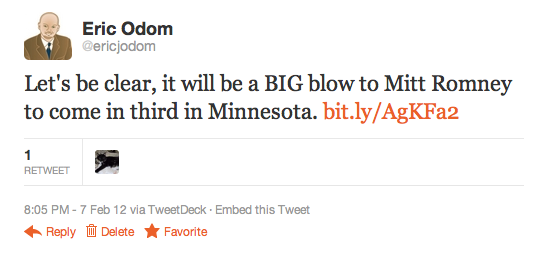
The above image is a tweet I sent out at 8:05 PM last night. At the time my thinking was that early reports showed a possibly damning result for Mitt Romney in Minnesota. This vibe began to strengthen not long after when both Ron Paul and Rick Santorum were beating Romney in counties surrounding the St Paul and Minneapolis area. At the same time, the counties around St Louis and Kansas City were going strong for Rick Santorum as well. We knew Romney wasn’t likely to do well outside of the major metro areas, but we had no idea he would fall in the cities as well.

But if that were the worst news of the night for Romney it would have been much better than what ended up happening in Colorado. Earlier I mentioned Colorado as Romney territory. I say that because in 2008 Romney dominated Colorado, blowing out McCain and Huckabee by a huge margin. Unlike Minnesota and Missouri, Romney had significant infrastructure and organization in place across Colorado. The fact that Romney lost Colorado is wildly damaging to the narrative that Romney can win big battleground states.

Additionally, while I can’t get into the minds of Romney’s advisors, my guess is Colorado is the first state they thought they would win, but lost. I mean, the polling indicated a loss in South Carolina and the Romney team downplayed expectations going into the southern conservative state. But Colorado… all indications were that Romney would walk away with it with no problems.

I honestly believe there might have been a serious miscalculation happening on the part of the Romney team last night. I think that since they knew all three states had non-binding delegates, they decided not to spend big money in Missouri and Minnesota. They assumed they would likely win Colorado, and while they spent significant money there, they didn’t pile on to seal the deal in a big way. As a result, they ended up getting trounced in all three.

The size of the contrast between Romney losing two states and three last night simply can’t be overstated. February was supposed to be his month. It was a time for him to trump the field and show he can carry a diverse range of states going into Super Tuesday. Two weeks ago he was looking decent in Minnesota, strong in Colorado and somewhat competitive in Missouri. Today he looks like a very weak, barely front runner.

You know who got hurt worse than Romney last night? Newt Gingrich.

The second candidate to go through a nightmare scenario last night is Newt Gingrich. It’s true the Gingrich failures didn’t get as much attention as Romney’s, but the long term effect will be far more damaging for Gingrich than it will for Romney.

First, Gingrich was nothing short of an afterthought in all three states, even though his choice to forgo the ballot only occurred in Missouri. How Gingrich finished dead last in Minnesota is beyond me. He didn’t do a whole lot better in Colorado, coming in a very distant third.

Second, Gingrich has openly admitted he needs Santorum out of the race in order for him to see victory. Gingrich has gone so far as to actually call for Santorum to drop out. Now, instead of Gingrich enjoying the possibility of splitting all the Super Tuesday states with Romney, he’ll be lucky to split half of them with Rick Santorum.

Which brings me back to Santorum… can he win?

Santorum is now a very legitimate candidate and he’ll likely get a couple million dollar strong boost to his campaign by the end of the week. I don’t think his chances are great in any of the states between now and Super Tuesday, so he would be wise to focus his energy on those states. If Santorum can do well in the debate planned for later this month, raise a ton of cash and continue to unify conservatives around the idea he can win as the Not-Romney candidate, he can possibly elbow Gingrich out for a better chunk of the Super Tuesday delegates.

But just as Santorum is a hurdle for Gingrich, Gingrich returns the favor by being a major hurdle for Santorum. Both candidates will be very competitive for the conservative vote in southern primary battles that begin happening on Super Tuesday and beyond.

With all four candidates in the race, Mitt Romney is still the front-runner and likely nominee. But if Santorum continues to gain momentum and Gingrich continues to have days like yesterday, we might have ourselves a serious fight to the finish.

-Eric Odom