Pennsylvania and New Mexico Trending Toward Obama

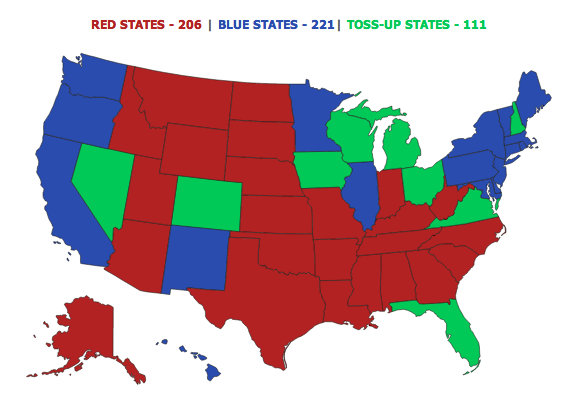
Each week we take a deep look at our 2012 Election Ratings Maps and re-evaluate the ratings accordingly. We recently shifted Missouri and North Carolina safely to red, with New Hampshire shifting to Toss-Up. Today we regret to publish our latest map with two states moving from toss-up to blue.

Pennsylvania and New Mexico.


The new projection map shifts Obama in to the lead in terms of electoral votes, coming in at 221 vs. 206 for Republicans. 111 electoral votes are up for grabs and 270 are needed to win.

Why Pennsylvania and New Mexico? Our ratings system includes a mix of historical data, current ground operations and campaign infrastructure, voter approval and broad poll averages. In New Mexico it appears as though the Romney camp is non-existent. Sure, there may be official presence, but it’s not the kind of presence you would see in a competitive state. To make matters worse, the latest Rasmussen Report poll shows Obama up by a whopping margin of 14%! The RCP average shows 10%.

Pennsylvania doesn’t perform much better. The current average is at 7.7%, but the latest polls suggest a margin of up to 9%. Romney is very active in Pennsylvania, but Obama is putting enormous resources into the state and there are no signs PA will give Romney a chance.

This is just a projection based on the data available today. The race is very fluid and could certainly change as the final stretch heats up, but right now it looks as though Pennsylvania and New Mexico are safe for Obama.

Which makes Romney’s path to victory extraordinarily difficult, but doable.


Uncommitted Voters Turning Against Obama

Earlier this week I wrote about the 8% lead Obama currently has over Romney in Pennsylvania when you average out all poll results.  The actually number may be more or less, depending on what the average margin of error looks like. But let’s assume the 8% points are right. If that 8% is correct, the following significantly applies.

Of the 8% to 10% of uncommitted voters out there only 29% of them somewhat approve of the job Obama is doing.

Polls over the past month have consistently shown a very close general election race between President Obama and Mitt Romney. The Rasmussen Reports daily Presidential Tracking Poll  has shown Obama’s support between 44% and 46% every day for weeks. During that same time frame, Romney’s support has stayed between 44% and 47%.

While some of those voters could ultimately change their minds, the winner could very well be determined by the eight percent (8%) to 10% of voters who routinely refuse to commit to either of the major party candidates. About half of them prefer a third-party option, and the other half are simply undecided.

The survey of 653 Uncommitted Likely Voters was conducted July 2-15, 2012 by Rasmussen Reports. The margin of sampling error is +/- 4 percentage points with a 95% level of confidence. Field work for all Rasmussen Reports surveys is conducted by Pulse Opinion Research, LLC. See methodology.

Could Romney convince 7 out of 10 of uncommitted voters that he’s the right direction to go in November? If he can, then purple states like Pennsylvania could indeed fall from Obama’s grip. Especially if the following holds.

Meantime, three and a half months before election day, Republican enthusiasm about voting this year has shot up since Mitt Romney clinched the nomination in April, from 36 percent of Republicans saying they were more enthusiastic in March to 49 percent now.

President Obama was helped to election in 2008 by a wave of voter enthusiasm among Democrats, however this year, Democratic enthusiasm is down a bit since March. Twenty-seven percent of Democrats said they were more enthusiastic about voting this year than they were in past elections, compared to 30 percent four months ago. And 48 percent of Democrats say their enthusiasm this year is the same as past elections, compared to 39 percent who answered the same question in March.

This race is definitely still a toss-up, but it’s now becoming increasingly clear that Obama is a weak candidate and can be defeating.

Barack Obama in Trouble in… Pennsylvania!

It’s one thing to discuss the struggles of both campaigns in states like Florida and Ohio. It’s a whole different ball-game when it comes to a state like Pennsylvania, a state Republicans haven’t won since 1988. Last time around John McCain got stomped, but Obama wasn’t extremely popular when it happened. The 2008 vote went 55% to Obama vs. 44% to McCain. In 2004 John Kerry got the better of George Bush by just 2 points, pulling in 51% vs. 49%.

Comparatively speaking, Michigan gave Obama 57% of the vote vs. just 41% for John McCain. Could Obama have lost 5% of his previous votes in PA? And is Romney making gains? Well, it all comes down to Philadelphia. And team Obama has to be a little concerned with the writing on the wall.

President Obama won Pennsylvania by more than 620,000 votes in the 2008 election, largely on the strength of his performance in and around Philadelphia: He won Philadelphia County by nearly 480,000 votes and the surrounding swing areas by roughly another 200,000 votes. His performance in the region, which holds about 40 percent of the state population, made what happened in the rest of the state close to irrelevant.

Yet after nearly four years in office, there are big questions over whether Mr. Obama can even come close to repeating that performance. It appears unlikely that African-Americans and young voters, who powered Mr. Obama’s big margins in 2008, will come out in the same numbers that they did last time around; a Pew Research Center last month found that, nationally, 60 percent of younger voters are giving a lot of thought to the election, a drop from 71 percent in 2008. A drop in voter enthusiasm in places like Philadelphia County – which is 44 percent African-American – puts the state’s 20 electoral votes very much in play.

According to the RCP average for Pennsylvania, Obama is leading Romney by about 8 points. Rasmussen has that gap closing to 6 points in its latest poll. Here’s where it gets interesting, though… While Obama leads Romney, he has yet to cross 50% in any poll of Pennsylvania voters. His average currently sits at 47.4%, suggesting he might have 7-8% of his previous support. Now this doesn’t necessarily mean those voters will jump to Romney. They may vote some other ay, they may stay home, or they may eventually come around. But right now they aren’t aligning with Obama and Romney hasn’t even really kicked his campaign into full gear.

Is it possible Romney can pick up support of independents in and around Philly, as well as the rest of the state, in a way that can make up the 8% he needs? Sure it is. It’s equally possible he can’t, of course, but the point is it’s possible.

And Pennsylvania being a possible loss for Obama is very, very bad news for Democrats.

Electoral Revolution Happening in Pennsylvania

Most of us outside of Pennsylvania look at the state at first glance and see dark blue in terms of political party strength. But upon deeper review, the state is actually making a significant turn away from the Democrat agenda. In 2010 Republicans managed to turn back a crushing Democrat majority against all odds, placing the state’s Congressional Delegation into control of the GOP. From all appearances, at the very worst the GOP doesn’t gain anymore seats, but they shouldn’t lose any big ground. At best, Democrats lose more seats and Obama loses the state.

Obama losing the state is more a longshot, but when you read between the lines you start seeing a scenario that has to have Democrats in full freak out mode.

As Democrats struggle to net 25 seats and win back the House majority in November, no single state reflects the party’s challenges more than Pennsylvania.

After all, Pennsylvania has gone Democratic in the past five presidential contests, and the apparent movement of the Philadelphia suburbs away from the GOP during the past two decades suggests a fundamental political shift in the state.

But if the southeastern corner of the Keystone State has started to resemble New Jersey and Connecticut, Western Pennsylvania increasingly looks like West Virginia or southeastern Ohio, areas where voters have started to think and behave more like Republicans. This movement of working-class voters toward the GOP has helped offset the partisan trend in the Philadelphia suburbs, keeping Pennsylvania an interesting and competitive state.

Pennsylvania swung wildly between 2006 and 2010, as most of the country did.

Democrats gained a total of five House seats in the Keystone State in the 2006 and 2008 elections — one-tenth of their total haul. After the ’08 elections, Democrats held 12 of the state’s 19 Congressional districts. Two years later, the numbers flipped, with Republicans sitting in 12 seats.

Redistricting after the 2010 census, of course, has further changed the state’s arithmetic because the GOP-controlled state Legislature made it more difficult for House Democrats to make gains by packing Democratic voters together, including throwing two incumbent Democrats into the same district.

In terms of the POTUS race, Obama leads Romney by 8 points in the average. It should be noted, however, that Obama best performance is 48& in the average, meaning he has yet to gain support of the majority of those polled. Romney has a lot of ground to gain, but he is gaining. At the end of May a major poll had him down 12% and he’s trended upward ever since.

In 2008 Obama won 55% of the vote in PA. The fact Obama is currently averaging 48% is telling, and shows Obama may have lost 7-8% of his support. Or, at least, that 7-8% hasn’t yet decided to join back up with him. If that is the case, and it appears it is, Romney has an huge opportunity here and puts Pennsylvania in play in a very big way. PA has 20 electoral votes, and if those flow in the direction of Mitt Romney, Barack Obama is in serious trouble.

It’s fairly safe to assume that if Romney started gaining steam in PA, he’ll also be doing the same in states like Michigan and Wisconsin. Once those states begin trending away from Obama we’ll be facing an entirely different scenario. One that could include a landslide defeat of Barack Obama.


PA Senate Candidate Steve Welch Releases Strange Campaign Ad

I’ve seen a lot of campaign ads, but this one might take the cake in level of “I didn’t expect that” results. The ad, put out by Pennsylvania Senate Candidate Steve Welch, is a sort of satire attempt to make it appear as though a serious investigative report is airing on TV. I use the term satire loosely, because the ad is actually fairly factual.

Bob Casey & Barack Obama - Separated at Birth

http://youtu.be/eoF3-UemPWQ

Democrat Senator Bob Casey won Pennsylvania with 59% last time around and the seat is considered “likely Democrat” in 2012. That said, there’s a plethora of candidates running on the GOP side it’s possible a very credible challenger emerges to make the race competitive.

Republican primary candidates include:

  • Marc Scaringi, atty., frmr. Santorum staffer
  • Laureen Cummings, Scranton Tea Party dir.
  • John Vernon, U.S. Army vet.
  • Steve Welch, bman
  • David Christian, bman
  • Tom Smith, Indiana-Armstrong Patriots chair
  • John Kensinger, pharmacist
  • Tim Burns, bman, ’10 PA-12 cand.
  • Sam Rohrer, PA Americans for Prosperity dir., frmr. st. Rep., ’10 Gov. cand.
  • Pat Meehan, U.S. Rep.
  • Jim Cawley, LG
  • Kim Ward, st. Sen.
  • Keith Loiselle, bman
  • Charlie Dent, U.S. Rep.
  • Jim Gerlach, U.S. Rep.

-Eric Odom

Via: Political Wire & Candidate List via CookPolitical.com

Obama’s Job Approval Now at 39%

Joe Biden und Barack Obama in Springfield, Ill...

Image via Wikipedia

I still maintain that Barack Obama is going to be incredibly difficult to defeat. Powerful incumbent Presidents aren’t removed from a second term easily. Barack Obama has not fully initiated the might of his campaign infrastructure and once he does we’ll all feel the wrath of his re-election campaign.

That said, it’s got to be heavy on Obama’s mind that his Gallup Job Approval rating is now under 40%.

President Obama‘s summer woes have dragged his approval rating to an all-time low, sinking below 40% for the first time in Gallup’s daily tracking poll.

New data posted Sunday shows that 39% of Americans approve of Obama’s job performance, while 54% disapprove. Both are the worst numbers of his presidency.

Obama’s approval rating has hovered in the 40% range for much of 2011, peaking at 53% in the weeks following the death of Osama bin Laden.

But Americans’ view of his job performance continued to tick downward as the debt-ceiling debate heated up. By the time he signed legislation averting a federal default, he was mired in the low-40% range.

That’s a brutal number and if it’s an accurate look at the electorate, Obama is indeed in serious trouble. Obama’s numbers are already under water in Florida, Ohio, Pennsylvania, Virginia and other battleground states he’ll have to fight for to keep his seat. Now that his national approval numbers are in the hole, the chances of defeating this powerful incumbent are becoming better by the day.

-Eric Odom

Barack Obama’s Curious Road Map Strategy

President Barack Obama addresses the House Dem...

Image via Wikipedia

Last week I wrote about the “toss-up” battleground states. You can view that list here. I included the six states Obama will have the toughest fight in, all of which are just as winnable for the GOP as they are for Obama.

The RNC’s Rick Wiley has a post over on the RNC blog that brings about some interesting thoughts. Primarily, Wiley points to several recent surveys in Michigan, Pennsylvania, New Hampshire and Wisconsin that show Obama’s approval rating beginning to tank. All four of these states should be safe territory for Obama, but they aren’t. Wiley explains why in the full post.

The Obama campaign should pay close attention to four states that represent 50 electoral votes – Michigan, New Hampshire, Pennsylvania, and Wisconsin. Obama easily won these states by an average margin of 13 points in 2008, and together they’ve mustered only one win for a GOP Presidential nominee in the last five Presidential elections (George W. Bush carried New Hampshire with 48% in 2000).   But recent polling in these states, and overwhelming GOP victories in 2010, shows Obama isn’t just weaker than he was in 2008, but he is in real danger of losing electoral votes.

In Pennsylvania, the biggest electoral prize of the four with 20 electoral votes, Obama’s polling has been dismal.  Two surveys conducted in June by Quinnipiac and Susquehanna Polling and Research show his re-elect numbers at 48% and 44% respectively.  Obama’s job approval in the Susquehanna survey was upside down by 7 points (41% approve, 48% disapprove).  This week, Public Policy Polling (PPP), a Democrat firm, released a survey showing Obama again upside down in his job approval – 46% approve to 48% disapprove – and showed him tied at 44% in a theoretical matchup against a candidate for the Republican nomination.   Democrats were swamped in Pennsylvania in 2010, when an motivated electorate propelled Republicans to take control of the Governorship, a US Senate seat, the State House, and five US House seats.

Recent polling in New Hampshire, conducted by the University of New Hampshire for WMUR, also showed the President’s job approval upside down with 46% approving and 49% disapproving.  The poll also showed him behind in a theoretical matchup with a Republican candidate.  Last month ARG released a survey showing his approval rating upside down by a whopping 15 points (39% approve, 54% disapprove).  In 2010 Republicans rolled in New Hampshire as well, knocking off both members of the US House delegation and regaining control of both chambers of the state legislature.

Public polling in Michigan and Wisconsin has been less frequent, but the drubbing Democrats took in 2010 cannot be ignored.  In states that voted for Barack Obama by 16 and 14 points respectively, Republicans wrestled the Governorship of both states from the Democrats, as well as a US Senate seat in Wisconsin, two US House seats in each state, and three state legislative chambers (resulting in full control of the legislature in each state). That historical perspective combined with Obama’s abysmal economic record and new taxes and regulations on the auto industry should make Team Obama think twice about taking too many states from his 2008 coalition for granted.

Earlier in the post Wiley says strategists within the Obama camp are looking at setting up shop in states like Arizona and Georgia as a part of their 2012 road map. Wiley calls this curious and indeed it couldn’t be more puzzling. John Kerry lost Arizona by 11 points and McCain beat Obama by 9. In Georgia Kerry lost by 17 and Obama by 5.

This strategy, if true, would mean that either a) Obama’s political strategy is becoming desperate, or b) they’re trying to force Republicans to spend money where they shouldn’t have to.

-Eric Odom

Mitt Romney Slams Obama on Allentown, PA Fail

Back in 2009 Barack Obama visited a factory in Allentown, PA while pitching his plans for economic recovery. That factory is now shut down.

Since Obama has taken office, the following has become reality:

  1. Pennsylvania lost some 100,000 jobs
  2. 39,800 jobs lost were in manufacturing
  3. Pat Toomey won election as Senator
  4. 12 out of 19 house seats are held by Republicans after the 2010 election cycle
  5. PA is currently a “lean Dem” state but only by a slim margin
  6. PA provides 20 electoral votes

Which makes this new Mitt Romney web ad highly effective.

Bingo!

-Eric Odom