Liberty News Network (parent of CampaignTrailReport.com) projects possible POTUS race outcomes via our tracking site at VoterTeaParty.com. These projections are fluid and we use a custom algorithm that consists of historical voter data, past two cycles of voter trends, current voter landscape, polling averages and voter enthusiasm. Today we’re moving two states, Arizona and New Hampshire.
Today’s projected electoral map.
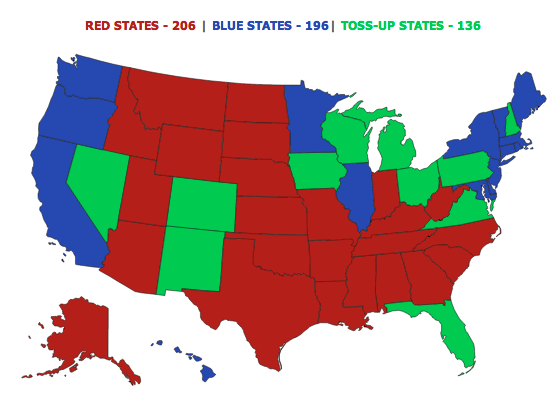
Arizona is now firmly in the Romney column. We had initially placed Arizona into the “toss-up” column while waiting to see how the Senate race shakes out. It appears as though Jeff Flake is getting his footing and has a great shot at winning the open Senate seat. As a result of this, along with strong statewide GOP infrastructure and an Obama administration that has been brutally offensive against the state, it’s likely Romney can win Arizona.
We also moved New Hampshire to “toss-up” from blue. New Hampshire has always been a hard state to call. Our hesitation to date has really been anchored by a lack of enthusiasm for the Romney campaign vs that of Obama’s base. While we’re shifting this state to toss-up, it should remain clear this is state is completely up for grabs and neither candidate currently holds a verifiable advantage.
This leaves 136 electoral votes up for grabs. Meaning, the road to 270 electoral votes is extremely challenging for both campaigns. Each of these states, with the exception of maybe Pennsylvania and New Mexico (both slightly favor Obama), can be turned in either direction.
It’s our belief that if the Romney/Ryan ticket begins to gain traction in states like Nevada, Wisconsin and Iowa, the same will happen by default in Florida and Virginia.
Romney/Ryan can win the needed 270 electoral votes without Ohio. They need Florida, Nevada, Iowa, Virginia, and either Wisconsin or a combination of Colorado and New Hampshire.
It’s a tough road against an incumbent, but very possible.

The four remaining candidates are likely spending a good deal of the day preparing for tonight’s CNN GOP debate in Mesa, Arizona. Their campaigns are likely in high gear working the phones statewide in both Arizona and Michigan. The two states suddenly became a little more important when Rick Santorum surprised the field and won the Missouri, Minnesota and Colorado nod a few weeks back. That turn of events signaled to the following states that Romney was not invincible, and in fact, was quite vulnerable.
A month ago both Arizona and Michigan were assumed to be the “cherry on top” for a decent Romney sweep through February. Sure, it wasn’t expected that Romney would perform well in Missouri, but it was definitely expected he would be very competitive in Minnesota and ultimately win Colorado. While this positioning would not provide any delegates, it would throw water on the fire of the narrative that Romney doesn’t have wide support across battleground states. Instead, Romney lost all three, adding fuel to the fire of the narrative that he can’t win a broad base of support in battleground states.
The former front-runner now finds himself in second place to Rick Santorum, looking ahead to a possible loss in Michigan, a state where he was once thought to be extremely safe. The RCP average for Michigan has Santorum up by about a point. Romney is up by 8% in Arizona.
What does it all mean?
Well, regardless of the results on Tuesday, the game will not change. What happened several weeks ago in Colorado is what changed the game. The only thing that could somewhat shake the ground is a win in Michigan for Santorum, as it would again provide an injection of much needed campaign cash and momentum. A loss in Michigan would have the opposite effect for Romney. That said, no candidate will drop out and I don’t expect that national positioning will change much until after Super Tuesday (Santorum is the front-runner by just under 6%).
Romney will go on to win the states he’s expected to win on Super Tuesday (with the exception of maybe Washington). Rick Santorum and Newt Gingrich will fight to split the others. Ron Paul will pick up delegates with various lower tier finishes.
Super Tuesday isn’t far away, though, and that’s when we find out where we really stand. As of today, Gingrich is poised to only pick up Georgia with a first place finish. He might be able to do something in Tennessee, but that would be it for his first place possibilities. Santorum looks good in Oklahoma and Ohio. Romney should easily grab Vermont, Virginia and Massachusetts. That only leaves North Dakota, Idaho and Alaska, and I have a feeling Santorum might do well in those.
In the end I think Super Tuesday probably won’t answer any big questions. It could, however, clearly establish the fact that Romney is not at all the front-runner.
-Eric Odom


Image via Wikipedia
Last week I wrote about the “toss-up” battleground states. You can view that list here. I included the six states Obama will have the toughest fight in, all of which are just as winnable for the GOP as they are for Obama.
The RNC’s Rick Wiley has a post over on the RNC blog that brings about some interesting thoughts. Primarily, Wiley points to several recent surveys in Michigan, Pennsylvania, New Hampshire and Wisconsin that show Obama’s approval rating beginning to tank. All four of these states should be safe territory for Obama, but they aren’t. Wiley explains why in the full post.
The Obama campaign should pay close attention to four states that represent 50 electoral votes – Michigan, New Hampshire, Pennsylvania, and Wisconsin. Obama easily won these states by an average margin of 13 points in 2008, and together they’ve mustered only one win for a GOP Presidential nominee in the last five Presidential elections (George W. Bush carried New Hampshire with 48% in 2000). But recent polling in these states, and overwhelming GOP victories in 2010, shows Obama isn’t just weaker than he was in 2008, but he is in real danger of losing electoral votes.
In Pennsylvania, the biggest electoral prize of the four with 20 electoral votes, Obama’s polling has been dismal. Two surveys conducted in June by Quinnipiac and Susquehanna Polling and Research show his re-elect numbers at 48% and 44% respectively. Obama’s job approval in the Susquehanna survey was upside down by 7 points (41% approve, 48% disapprove). This week, Public Policy Polling (PPP), a Democrat firm, released a survey showing Obama again upside down in his job approval – 46% approve to 48% disapprove – and showed him tied at 44% in a theoretical matchup against a candidate for the Republican nomination. Democrats were swamped in Pennsylvania in 2010, when an motivated electorate propelled Republicans to take control of the Governorship, a US Senate seat, the State House, and five US House seats.
Recent polling in New Hampshire, conducted by the University of New Hampshire for WMUR, also showed the President’s job approval upside down with 46% approving and 49% disapproving. The poll also showed him behind in a theoretical matchup with a Republican candidate. Last month ARG released a survey showing his approval rating upside down by a whopping 15 points (39% approve, 54% disapprove). In 2010 Republicans rolled in New Hampshire as well, knocking off both members of the US House delegation and regaining control of both chambers of the state legislature.
Public polling in Michigan and Wisconsin has been less frequent, but the drubbing Democrats took in 2010 cannot be ignored. In states that voted for Barack Obama by 16 and 14 points respectively, Republicans wrestled the Governorship of both states from the Democrats, as well as a US Senate seat in Wisconsin, two US House seats in each state, and three state legislative chambers (resulting in full control of the legislature in each state). That historical perspective combined with Obama’s abysmal economic record and new taxes and regulations on the auto industry should make Team Obama think twice about taking too many states from his 2008 coalition for granted.
Earlier in the post Wiley says strategists within the Obama camp are looking at setting up shop in states like Arizona and Georgia as a part of their 2012 road map. Wiley calls this curious and indeed it couldn’t be more puzzling. John Kerry lost Arizona by 11 points and McCain beat Obama by 9. In Georgia Kerry lost by 17 and Obama by 5.
This strategy, if true, would mean that either a) Obama’s political strategy is becoming desperate, or b) they’re trying to force Republicans to spend money where they shouldn’t have to.
-Eric Odom


Image via Wikipedia
Consider me quite surprised. I didn’t see this coming at all. Yes, folks, Michigan Congressman Thaddeus McCotter will be joining the GOP field. He’ll be making his official announcement in Michigan tomorrow.
I say I’m surprised, but in reality it’s been reported for a week now that McCotter has made some moves towards this decisions. Specifically, he’s gone as far as paying $18,000 for his booth spot at the Iowa Straw Poll. McCotter has also been in Iowa quite a bit over the past two weeks.
Kathie Obradovich summarizes it quite well.
McCotter has concluded that Iowans think there’s room in the field for another candidate. He says he’s not sure he’s the guy. Odds are against him at this stage. But to the extent that he can stimulate a more robust debate about the role of banks in the economic recovery and U.S. relations with China, it will be a welcome change from the cookie-cutter soundbites that have dominated the campaign so far.
With that, I’ll be updated the candidates page tomorrow when the announcement is made.

In 2010 tea party candidate Dan Benishek ran for Michigan’s 1st Congressional District and shocked the state by coming from behind with a general election win. Benishek barely got the win, though, with just 52% of the vote in a slightly Republican district. No doubt he’ll be challenged again in 2012 and may have another tough race ahead of him. Movement activists should help where possible to ensure he keeps the seat.
Especially when Benishek continues to throw common sense into the conversation in Washington. I give you… exhibit A:
There are quite a few candidates like Benishek who we’re going to start tracking here on the Trail Report. Keep an eye out for those updates.
-Eric Odom