 Is the Tea Party dead?
While there are as many rallies and protests than years before, the Tea Party is not dead. It has gone in a different direction and gone where they can make the biggest impact. They infiltrated GOP Party and are starting to change its direction.
While the Tea Party is mainly conservative or libertarian in philosophy, the Tea Party was not formed solely in opposition to President Obama and the Democrat Party. It was years of abuse on both sides of the aisle.
FreedomWorks President Matt Kibbe famously said, “Sometimes you have to beat the Republicans before you can beat the Democrats.”
The GOP has become more of a moderate or middle of the road party and many in the Tea Party are trying to bring back fiscal conservatism. Earlier this year Senator Orin Hatch had a scare and had to have a runoff election against a Tea Party backed candidate.
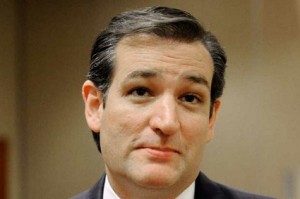
And last night, Tea Party backed Ted Cruz beat David Dewhurst:
Tea party leaders hailed Cruz’s performance as a sign of the movement’s political maturation. After bursting onto the scene in 2010, the tea party this year suffered defeats in a few Senate primaries, appeared divided in several GOP contests, and before Tuesday mustered just one clear victory — in Indiana, where state Treasurer Richard Mourdock ousted 36-year Sen. Richard G. Lugar (R-Ind.), whose missteps contributed to his primary defeat.
Following Mourdock’s victory in early May, conservative activists mapped out a strategy to emphasize the Lone Star State. The first step was keeping Dewhurst below the 50 percent threshold in a multi-candidate primary on May 29, triggering a runoff. That gave them two months to mobilize for a one-on-one contest.
Cruz’s win, they believe, could be a springboard to victories in other primaries this month.
This is a big blow to the “establishment” Republicans that have seemed to lose their way and spent like the Democrats before them.
Make no mistake the Tea Party is not dead. It may be flying more under the radar now, but it is making inroads in bringing back the GOP to its roots.


Most of us outside of Pennsylvania look at the state at first glance and see dark blue in terms of political party strength. But upon deeper review, the state is actually making a significant turn away from the Democrat agenda. In 2010 Republicans managed to turn back a crushing Democrat majority against all odds, placing the state’s Congressional Delegation into control of the GOP. From all appearances, at the very worst the GOP doesn’t gain anymore seats, but they shouldn’t lose any big ground. At best, Democrats lose more seats and Obama loses the state.
Obama losing the state is more a longshot, but when you read between the lines you start seeing a scenario that has to have Democrats in full freak out mode.
As Democrats struggle to net 25 seats and win back the House majority in November, no single state reflects the party’s challenges more than Pennsylvania.
After all, Pennsylvania has gone Democratic in the past five presidential contests, and the apparent movement of the Philadelphia suburbs away from the GOP during the past two decades suggests a fundamental political shift in the state.
But if the southeastern corner of the Keystone State has started to resemble New Jersey and Connecticut, Western Pennsylvania increasingly looks like West Virginia or southeastern Ohio, areas where voters have started to think and behave more like Republicans. This movement of working-class voters toward the GOP has helped offset the partisan trend in the Philadelphia suburbs, keeping Pennsylvania an interesting and competitive state.
Pennsylvania swung wildly between 2006 and 2010, as most of the country did.
Democrats gained a total of five House seats in the Keystone State in the 2006 and 2008 elections — one-tenth of their total haul. After the ’08 elections, Democrats held 12 of the state’s 19 Congressional districts. Two years later, the numbers flipped, with Republicans sitting in 12 seats.
Redistricting after the 2010 census, of course, has further changed the state’s arithmetic because the GOP-controlled state Legislature made it more difficult for House Democrats to make gains by packing Democratic voters together, including throwing two incumbent Democrats into the same district.
In terms of the POTUS race, Obama leads Romney by 8 points in the average. It should be noted, however, that Obama best performance is 48& in the average, meaning he has yet to gain support of the majority of those polled. Romney has a lot of ground to gain, but he is gaining. At the end of May a major poll had him down 12% and he’s trended upward ever since.
In 2008 Obama won 55% of the vote in PA. The fact Obama is currently averaging 48% is telling, and shows Obama may have lost 7-8% of his support. Or, at least, that 7-8% hasn’t yet decided to join back up with him. If that is the case, and it appears it is, Romney has an huge opportunity here and puts Pennsylvania in play in a very big way. PA has 20 electoral votes, and if those flow in the direction of Mitt Romney, Barack Obama is in serious trouble.
It’s fairly safe to assume that if Romney started gaining steam in PA, he’ll also be doing the same in states like Michigan and Wisconsin. Once those states begin trending away from Obama we’ll be facing an entirely different scenario. One that could include a landslide defeat of Barack Obama.


English: Official Congressional portrait of Congressman Jim Matheson. (Photo credit: Wikipedia)
Democrat Congressman Jim Matheson is right smack in the middle of the most epic battle of his political career. Rising conservative star Mia Love, a mormon, African-American, small town Mayor, won the GOP primary fight and will now face Matheson in November. Matheson would have been weakened against any GOP candidate in the newly created 4th district, but Love has something of an unexpected twist. National appeal.
Utah 4 is no longer a quiet race that can be fought locally without heavy statewide and even national influence. Now, far more scrutiny is involved and every move Matheson makes will become a campaign issue. While Matheson has some key votes that can help him in this heavily Republican district, such as his opposition to Obamacare, he openly supported/voted for the failed stimulus package and other liberal legislation that has further damaged the U.S. economy.
With this in mind, Matheson is now scrambling to gain favor among some of the more moderate-to-conservative voters he’ll need to survive the challenge from Love. The scramble is so intense that Matheson is even joining with Republicans to hold Eric Holder in contempt over the Fast & Furious scandal.
Rep. Jim Matheson will vote to hold Attorney General Eric Holder in contempt of Congress for withholding documents pertaining to a failed Justice Department sting that let guns get into the hands of drug runners.
Matheson, D-Utah, announced his position Tuesday, joining House Republicans, such as Utah Reps. Rob Bishop and Jason Chaffetz, who have railed against Holder’s reaction to the congressional probe into the Justice Department’s “Fast and Furious” operation. One of the lost guns was later used in the murder of U.S. Border Patrol agent Brian Terry.
That’s quite a profound pivot for a long time Democrat. And goes to show how some Democrats who have previously been able to command the outcome of their elections are now desperate to hang on.
Just how bad is it for Matheson? Well, the last major general election poll we have is one done by the Salt Lake Tribune. The poll showed Matheson up over Mia Love by 3 points (within the margin of error), but the poll was conducted BEFORE the GOP primary had concluded. We don’t have more current data at this time, but my guess is the race has tightened and Matheson’s internal polling data has their campaign freaking out.

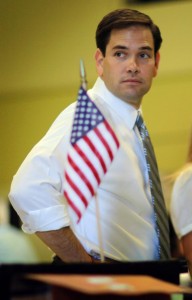 Oh now this is interesting
Even before the Republicans chose a presidential nominee it was widely assumed that Sen. Marco Rubio, R-Fla., would be at the top of anybody’s list of vice presidential candidates. The reasons are obvious: Not only is he young, charismatic and wildly popular with conservatives, but he could also help Republicans win a key state (Florida) and make inroads with Hispanics.
But knowledgeable Republican sources tell me that Rubio is not being vetted by Mitt Romney’s vice presidential search team. He has not been asked to complete any questionnaires or been asked to turn over any financial documents typically required of potential vice presidential candidates.
Although it is possible that Rubio may yet be asked to go through the vetting process, it has been nearly two months since Romney named his long-time aide Beth Myers to run his vice presidential search. The fact that Rubio has not been asked to turn over any documents by now is a strong indication that he is not on Romney’s short list of potential running mates.
I personally believe Marco Rubio will indeed be excluded from the options list when the rubber hits the road. Yes, there is still a possibility Rubio gets the call, and at this point there is no way to know what kind of discussions are happening behind the scenes, but I happen to believe Romney will pick someone outside of Florida.
Let’s face it. Florida will be an incredible battle come election week. I think Florida is currently about as toss-up as it can get, but I also think there are important places where Romney has a tougher fight ahead of him. Ohio, Colorado and Nevada to name a few. And, of course, now Wisconsin and Michigan appear to be somewhat in play.
If Romney’s internal data is showing a strong shot at Florida as the race stands today, he won’t need to go to a name like Rubio to seal the deal. He’s got other options more central to the nation and he’s not necessarily looking for a rock-star conservative to have on the ticket. In fact, I would think a name like Mitch Daniels would do more for Romney’s heartland credentials, without harming his reach to conservatives, than any other.
It’s anyone’s guess at this point, but if this report is true and Rubio really hasn’t been asked for anything listed above, it’s quite telling of what team Romney believes could happen in Florida.
-Eric Odom
Update: Romney camp claims Rubio is being looked at.

Now that primaries are shaking out we’re beginning to see a clearer picture of what we’ll be dealing with come November. While there is absolutely no way to know how it will all come down, we do have some indicators of what could happen and we’ve rated each race based on some of these indicators. The two key points we’re working to address is how the Senate divide will be set up after November and how big the divide will be.
For those who do not know, Liberty News has a daily tracking site up at VoterTeaParty.com. The main page acts as a tracker for the POTUS race, but you can click here to see our outlook for the Senate races. (Or see image below for our outlook as of the time of this post)
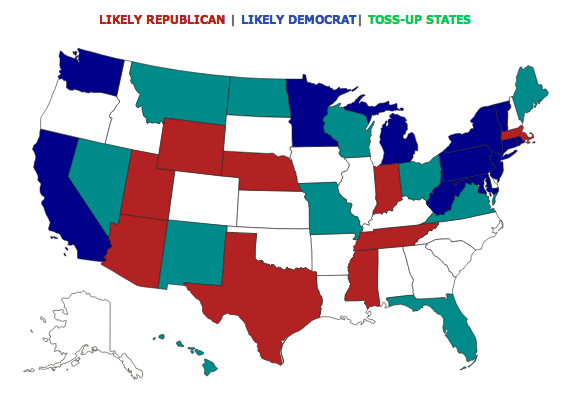
Current Layout: Dems 51, GOP 47, Indy 2
First, let’s note that while there are currently two Independent Senators, Republicans cannot count on them to enact a conservative agenda. Bernie Sanders (Vermont) isn’t going to ally with conservatives and Joe Lieberman (Connecticut) is retiring. Connecticut is likely to go Democrat in November so this really places Obama’s agenda at 53 strong in the Senate. This means Republicans must gain an absolute minimum of four Senate seats in November.
Using the map above you can see what we believe would happen if the elections were held today. A key note here is that of all the states likely to go to Republicans, only Nebraska has a Democrat currently in the seat. Meaning, of the states we believe will go Republican in November, only one of them would be a gain.
Yes, it’s true Democrats have far more seats to defend than Republicans. That said, most of the Dem seats are fairly safe for them in November. Republicans, on the other hand, have some
Continue reading »
I would have posted results for the Nevada GOP Caucuses up sooner, but the Nevada GOP went through a full day of embarrassing itself yesterday and we didn’t have the final results until early this morning. The results are in and they’re showing Mitt Romney with another commanding win.
- Mitt Romney – 50% – 10 delegates
- Newt Gingrich – 21.1% – 4 delegates
- Ron Paul – 18.7% – 3 delegates
- Rick Santorum – 9.9% – 2 delegates
The numbers on Romney were about exactly as expected. Newt Gingrich underperformed in Nevada, considering the polls suggested he would pull at least 25%. Also notable is the fact that Both Ron Paul and Rick Santorum performed slightly better than expected. It’s possible those who had previously shown support for Gingrich shifted to Santorum and Paul.
The full delegate count (pending possible shifts from Iowa):
- Mitt Romney – 97
- Newt Gingrich – 30
- Rick Santorum – 16
- Ron Paul – 7
- Jon Huntsman – 2
-Eric Odom


If you missed the leading question to the CNN GOP Debate last night, and the response, you can view that HERE.
That incident is now engraved in the granite-hard tomes of history and will forever ooze its greasy drippings and epitomize the prejudice and bias of the Socialist Liberal Media for all of posterity to see how the much touted “American Free Press” became the propaganda tool of a sitting President.
It’s not as if any Tea Party member has not been a target of the SLIME’s sorry, sleazy song, but it is certainly satisfying to witness the public outing and spanking of a propaganda shill, pretending to be a journalist.
That it was Newt Gingrich that turned the attack around and against the erstwhile reporter, who had so “cleverly” hidden his eager hostility behind his sarcastic smile, made the incident surprisingly delicious.
Might we finally have seen an incident “that broke the camel’s back” and launched a national outrage against a “media,” not just obviously in the tank for the Joker in the White House, but obviously in the tank for Obama Once Again?
One can only hope!
El Rushbo eloquently iterated it as usual:
“What ABC is doing is they’re clearing the field here. That’s what this week was about. That’s what the Marianne Gingrich interview is about. Now, a lot of people said, “Well, how’d they get hold of Marianne Gingrich, Rush? Duhhh, how come they found her?” She basically gave interview to Esquire magazine in 2010 that had some of this stuff in it. So she’s been out there with this, but the Esquire magazine interview did not launch. But I’m sure that ABC… How many ex-wives of Democrats has ABC sought out? They just don’t do it. So they know what they’re doing. They know they’ve got a president who can’t win on his record. Now, that’s another thing. This always gets me. Are journalists monogamous? Are journalists faithful? Are they clean and pure as the wind-driven snow?”
And Charles Hurt in the Washington Times advances the interrogatory even further, asking what I have also asked a time or two: “There is growing consternation in Republican circles and among conservatives over why Republicans keep allowing the various Communist, leftist and otherwise anti-American TV networks to host GOP debates.”
Charles is particularly Hurt-ing with the following refrain:
“…So ferocious was the rebuke of the low-foreheaded moderator that he meekly tried to back out.
“This story did not come from our network,” he whined. In full attack, Mr. Gingrich pressed on.
“John! John!” he interjected with unstoppable anger. “It was repeated by your network. You chose to start the debate with it. Don’t try to blame somebody else. You and your staff chose to start this debate with that.”
And once again, the audience roared its approval, voters watching at home leaped to their feet and whooped their approval and the elites in the media once again recoiled in disbelief and confusion…”
Please delight in that Article HERE.
Although I should not and cannot argue with the eloquence and the accuracy of the Limbaugh and Hurt rebukes, I have something to add to the saucy mix of this retaliatory dish.
In the turmoil of poor ABC’s “ethical quandary and dilemma” about when to air the now-famous and notorious “entrevista” with Newt Gingrich’s ex-wife, Marianne, it was particularly interesting that they actually considered waiting until AFTER the South Carolina primary. Rush goes into this somewhat, but there was one detail that did not get its due attention.
That detail, that little morsel of blogular speculation is apt to make one with a Tea Party nose take pause and wonder. Would they have let the “mystery” of the interview just bubble and boil in the minds of voters, as the Primary process moved on? How would the voters have voted in the voting booth as they pondered how to cast their vote, with doubts simmering in the recessess of their minds, so cleverly filled by our comrades at ABC?
Had Drudge, as Limbaugh says, not pre-empted ABC, would ABC have done that? I don’t put it past them. Just look at the timing of the questions of alleged improprieties they leveled against Herman Cain.
Why do we let them toy with us like this? It borders on the edge of evil, don’t you think?

Image via Wikipedia
Memorandum
To: Interested Parties
From: Rick Wiley
RE: GOP Voter Registration Advantage
Date: January 17, 2012
The GOP has the momentum. It’s all in the numbers.
The Iowa Caucus and the New Hampshire primary brought out a record number of voters—many voting Republican for the first time in their lives. With over 70 percent of Americans looking for a new direction, voters are turning decidedly to the Republican Party.
An analysis of voter registration numbers demonstrates that the promising trend is not isolated only to Iowa and New Hampshire. In every battleground state for which there is relevant registration data available, the GOP has either narrowed the registration gap or increased our lead since 2008. And that’s bad news for Democrats.
In Colorado, Florida, Iowa, Nevada, New Hampshire, New Mexico, North Carolina, and Pennsylvania, the GOP enters 2012 from a stronger position. All are states Team Obama has identified as necessary to their pathway to victory. In all of these states, the net change from 2008 to 2011 (or early 2012 in some cases; see chart below) favors the GOP.
(Note: the other battleground states, Indiana, Virginia, Minnesota, Wisconsin, Michigan, Washington, and Ohio do not report registration in a way that makes such analysis possible.)
| STATE | 2008 ADVANTAGE | 2012 ADVANTAGE | NET CHANGE | DATE REPORTED |
| Colorado |
GOP +0.3% |
GOP +0.5% |
GOP +0.3 |
12/1/2011 |
| Florida |
DEM +5.9% |
DEM +4.9% |
GOP +1.0 |
9/1/2011 |
| Iowa |
DEM +5.1% |
DEM +1.5% |
GOP +3.6 |
1/3/2012 |
| Nevada |
DEM +7.7% |
DEM +7.6% |
GOP +0.1 |
10/1/2011 |
| New Hampshire |
DEM +0.2% |
GOP +1.1% |
GOP +1.3 |
12/15/2011 |
| New Mexico |
DEM +18.4% |
DEM +17.4% |
GOP +1.0 |
1/31/2011 |
| North Carolina |
DEM +13.8% |
DEM +12.5% |
GOP +1.3 |
11/26/2011 |
| Pennsylvania |
DEM +15.4% |
DEM +13.5% |
GOP + 1.9 |
1/2/2011 |
Furthermore, there are only a handful of states in which the net change from 2008 to today favors Democrats, and all are reliably blue states. Needless to say none of those is on the GOP path to 270 electoral votes. That means the GOP enters 2012 with a stronger position in all remaining states—all battleground states included—as compared to 2008. As enthusiasm during the nominating process continues to favor us, we expect our registration position to continue to improve.
This adds up to trouble for Democrats. Their turnout efforts are already complicated by the fact that there is less enthusiasm on the Democratic side. Many Democrats, while not yet prepared to jump ship, are dispirited enough by Obama’s failed promises that they could likely sit out 2012.
A Gallup poll released this week corroborates the trend observed in the registration data. The number of self-identified Democrats and Democrat-leaning independents is down sharply since 2008, while the number of Republicans and Republican-leaning independents continues to tick upward.
According to Gallup, in 2008, 52 percent of Americans identified as Democrats or Democrat-leaning independents; 40 percent were Republican or Republican-leaning. By the end of 2011, both groups stood at 45 percent. In three years, the 12-point Democrat advantage evaporated entirely.
So while 2008 represented a record high for Democrats, 2011 marks the lowest point since Gallup began reporting these figures in 1991. (In 1991 the Democratic figure was 44 percent.) In other words, Democrats have gone from a record high in 2008 to a low-water mark in 2011.
As Gallup reports, the 2011 numbers are “similar to 2010, when the Democrats had a 1-point advantage in leaned party identification.” Republicans saw sweeping victories in 2010, and now, as we enter 2012, our numbers look even better. Meanwhile, as the media focus remains on the Republican candidates and their efforts to highlight the failings of President Obama and their respective solutions, Republican appeal should only grow.
There are many ways to quantify the Republican advantage in 2012. Partisan registration and party self-identification data are just two such ways, but they unambiguously point to the fact that the momentum is indeed on the GOP side.
###

Copyright © 2011 Vanguard of Freedom
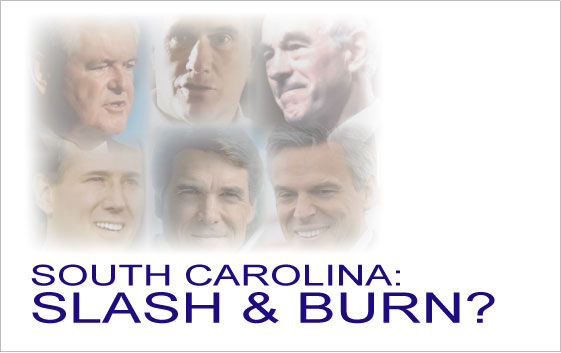
A word about the politics of the South. Irrespective of the impending “slash and burn” politicking that South Carolina is famous for, there is one thing to note about the Politics of Dixie.
Because of the volatility of politics, there is at times a kind of amnesia that sets in that tends to obscure historical trends that tend to dominate the dynamics of regions, candidates, and political strategies and their outcomes.
Some actually forget because they would rather not remember the “tragedies” of the past.
But unique to the South until “recently” is the factor that the South was essentially “Democrat.” Local and state politics were dominated by a Democrat politic, versus the Republican alternative. I won’t get into the reasons for it. Suffice it to say that the South voted “Democrat” in State and Local elections and “Republican” in national elections.
A judge in Central Texas remarked to me in January of 2005 at an inauguration ceremony, lamenting that the election he had just won would be his last, because he felt he had served enough terms, wanted to give somone else a chance, and…. (wait for it)… was too old to change parties. He felt that to win in the next election he had to switch parties and run as a Republican.
The head of the county Democrat party in that region in 2005 lamented that Democrats had been changing their party affiliation, because if they wanted to win, they had to run as Republicans. There was little change to their platform, he said; however, if they expected to be elected, they had to assume the “Republican” brand, or risk being left out.
Those were the days I refer to as the early George Bush days, post 9/11. Years of negative campaigning and mega-spending by the Democrat party against George Bush and by 2008, one could still be a Republican, but one certainly did not want to be associated with the “George Bush” brand.
However, the inroads Republicans achieved into Southern politics at the state and local levels remained a significant advancement, and Republicans are no longer associated or identified as easily with the label of “Yankee pointy headed-liberals,” although that might still apply to some in the current slate of candidates.
The South held at one time that it would be “a cold day in hell” before a Democrat even considered voting for a Lincoln Republican, given the sentiments of North-South (as in “Civil War”) politics. Those were “Yellow Dog” Democrats.
To reiterate a famous Democrat quote: A Southerner would rather “vote for a yellow dog before they would vote for any Republican”.
Later emerged the “Blue Dog” era. (See this article for historical significance.)
“Moderate” Democrats could still be Democrat, but vote with Republicans in certain issues.
The 2010 backlash against Barack Obama and his politics of Socialism, bucked by the Tea Party Tidal Wave, and vindictive Democrat Party pay-back, slashed the Blue Dog “membership” in Congress by half. And If Rush Limbaugh is to be believed, 2012 will usher in another blow to the Democrat Party, this time not just in the South, but nationally as well.
But what is “tender” to Southern Republicans today is not so much the “moderate” Republican slate of candidates that has been culled by the Liberal media and served up for South Carolinians with a side of hominy grits, black-eyed peas, and collard greens. It’s the vindictive, penalizing politics of Barack Obama. It includes jobs, the economy, jobs, and the economy, and jobs.
Oh, and lest I forget: jobs and the economy!
And primarily significant is the Barack Obama Administration handling of the Gulf of Dixie B.P. Deepwater Horizon oil spill. This factor is akin to the civil war “invasion” of Dixie by the Northern Yankees. It came as a devastating blow to the South, economically on the heels of a series of hurricanes that ravaged Mississippi, Florida, Alabama, Louisiana and Texas. That the region is recovering from this does not mitigate the sting of the political effects that came from the Obama administration.
In fact, the Gulf states are recovering despite Obama politics, though Socialists might rally to take credit for any improvement. Mississippi’s recovery is in large part due to Haley Barbour and team and their efforts at making Mississippi “business friendly,” boosting employment in the rebounding furniture building industry, as well as attracting a Toyota facility in Blue Springs, and a Nissan plant in Canton, counting, of course, the resultant sub-contracting entities that provide parts, off-plant assembly, and the consequent service and product industry that results in an accelerating economy.
Louisiana economic acceleration is largely due to Governor Bobby Jindal, his Chief of Staff Tim Teeple and team, who did not sit around and wait for a federal rescue from the Gulf Spill fiasco.
Let’s also not forget the Obama Administration National Labor Relations Board’s suit against Boeing in South Carolina, which attempted to shut down the plant because it was not a Union facility.
Majorly affected by the economic tragedy of Obama-nomics in the South are Southern Blacks, who voted for Obama in 2008. Will they remain loyal to Barack Obama because of “race?” This, I believe, is a significant reason why Obama will exploit the race issue in his upcoming run for the Presidency in 2012, and indeed is already doing so, under the guise of “class warfare.” Indeed, that is his only recourse, and it should be expected and exploited by Republican campaign efforts as well, with a strategy that counters it.
In fact, this Dixie Oil Spill issue alone might see a resurgence for Rick Perry in South Carolina, unless his campaign is not savvy enough to include it.
There need not be a slash and burn Primary election battle among Republicans in South Carolina, although there may well be. But if there is any way to coalesce, if not behind a candidate, certainly then in a movement against Barack Obama. It would be a gravely and strategically missed opportunity if it were not to happen in the coming days in South Carolina.
Here can be the Obama waterloo, or at least the launch of that battle. It would add a unique Southern flavor to national political cuisine politely served with Dixie hospitality as the 2012 campaign heats up.
To paraphrase an old adage, Political revenge, in the North as in the South, as we all know, is a dish: best served cold. The colder the dose, the “better” the burn, the more effective the frost-bite.
Regardless of who is slashed and who is burned, South Carolinians next week will choose for themselves and possibly for the nation, who best will deliver that dish on November 6, 2012.
Vanguard of Freedom Network / Patriot Action Network / Liberty News Network
Earlier this week I was involved in a conversation where I suggested one of Rick Santorum’s biggest problems in the ad/media/messaging war going into South Carolina is going to be his love for earmarks and earmark spending. What makes it worse is that Santorum is on the record multiple times defending his use of earmarks.
As if that isn’t bad enough, Townhall has a video out showing Santorum hitting hard on the libertarian and tea party mindset. Rick Santorum is a staunch social conservative so this is partially understandable. What I don’t understand, though, is his apparent dislike of tea party influence in the Republican Party. Yes, it might be the case we tea partiers are about 95% focused on fiscal issues and getting the government out of our lives, it in no way means we aren’t at all concerned about social issues.
This will probably be a problem as it starts to spread.
For the record, I’m not hitting on Santorum with this post. I’m just telling you what is going to be used against him by those with millions to spend. You know who I’m talking about.
-Eric Odom