Let’s face it… Ron Paul isn’t going to be the nominee

Ron Paul taking questions in Manchester, NH

I know, it’s a strong statement. And I know, a lot of my close friends aren’t going to like it. I’m hoping some of them may tell me what I’m not seeing here. Until then, I’ll say what I’m seeing.

So here it is… Ron Paul just can’t win this thing.

In order for Paul to have a shot at a completely discombobulated GOP convention, he would need to arrive armed with an overwhelming number of delegates. In the off-chance the convention does become brokered, Paul would need to be able to rally half the delegates in back room dealing and negotiations.

Back Iowa I thought there was some room for a play in this direction. The Paul got thumped in New Hampshire where he should have done better. Yes, he got second, but Romney beat him by around 40,000 votes. Paul was a non-factor in Florida and South Carolina, which made Nevada the place for him to flex his Caucus muscle and prove he could organize in that type of environment.

That didn’t happen.

In fact, Nevada was somewhat of an embarrassment for Paul considering his campaign outspent the rest of the campaigns in media this year. According to financial records, Ron Paul almost doubled Mitt Romney in media buys since January 1st.

Paul has spent the most money in the state since January 1 with $869,650 compared to Romney’s $488,460 and “Restore Our Future’s” $73,240. Neither Newt Gingrich nor the super PAC support his candidacy have spent money in the state since the first of the year.

So in Nevada Ron Paul was well organized, it was an environment favorable to his style of campaigning, and he outspent his opponents in media. How is it then that he finished third behind Newt Gingrich, and a whopping 31% behind Mitt Romney?

Looking ahead into the February Caucuses and Primaries, I don’t see a single state where he’ll do any better. The same can easily be said for Super Tuesday.

Right now Ron Paul looks to carry an average of 10%-15% of the delegates. Not all state delegates are locked in, so that number could fluctuate by convention time, but I can’t at all see a scenario unfold where he can find another 35% of the delegates.

I’ve got some friends trying to convince me Paul still has a shot at this and I just don’t see it. Is there a place where this will all change? Is there some path to victory I’ve overlooked?

-Eric Odom


Nevada results are FINALLY in… Romney by a landslide

I would have posted results for the Nevada GOP Caucuses up sooner, but the Nevada GOP went through a full day of embarrassing itself yesterday and we didn’t have the final results until early this morning. The results are in and they’re showing Mitt Romney with another commanding win.

  1. Mitt Romney – 50% – 10 delegates
  2. Newt Gingrich – 21.1% – 4 delegates
  3. Ron Paul – 18.7% – 3 delegates
  4. Rick Santorum – 9.9% – 2 delegates

The numbers on Romney were about exactly as expected. Newt Gingrich underperformed in Nevada, considering the polls suggested he would pull at least 25%. Also notable is the fact that Both Ron Paul and Rick Santorum performed slightly better than expected. It’s possible those who had previously shown support for Gingrich shifted to Santorum and Paul.

The full delegate count (pending possible shifts from Iowa):

  1. Mitt Romney – 97
  2. Newt Gingrich – 30
  3. Rick Santorum – 16
  4. Ron Paul – 7
  5. Jon Huntsman – 2

-Eric Odom

Gingrich calls for Santorum to get out of race

JACKSONVILLE, FL - JANUARY 26:  Republican pre...

Image by Getty Images via @daylife

I don’t recall Newt Gingrich being in favor of candidates trailing in polls to drop out after Iowa. After all, in that scenario it would have been himself who needed to bail out of the race. But now that Gingrich is running second in Florida and neck and neck with Romney nationally, he wants that standard to be in place. At least, that’s the case when it comes to Rick Santorum.

GOP presidential candidate Newt Gingrich says rival Rick Santorum should take a look at the poll numbers, which show Gingrich beating him, and drop out.  

“The longer conservatives stay split, the harder it’s going to be for us to [beat Romney],” Gingrich said on FOX and Friends on Tuesday. “And I think that we risk not being able to beat Obama unless we get a conservative. I have to win the nomination.”

Santorum is sapping conservative votes from Gingrich, the former House speaker said. Santorum, appearing just moments after Gingrich, countered.

“I don’t think either one of them are the right choice,” Santorum said, referring to Gingrich and front-runner Mitt Romney. “And if you want to look at the real conservative, we’re the real conservative that can win.”

First, Newt Gingrich does have a point here. There is somewhat of a split on the conservative side of the GOP vote. That said, Ron Paul contributes to this as well and if Newt Gingrich can’t convince those voters that he is the best of the three then he needs to make changes in his own message to accomplish it.

Second, Rick Santorum is picking up steam. In fact, Santorum has gained about the same 2% that Gingrich lost on the national average during the past two weeks. He’s now grabbing some big conservative endorsements and he may end up doing a lot better in Florida than we all originally expected.

It’s still early in this race. While a Florida win makes the trip to the convention much easier, it can be done without Florida and anything can happen. I agree it’s probably frustrating for Gingrich, Santorum and Paul to see the more conservative vote being spread around, but that’s the way this works and it’s their job to fix that through their message.

My two…

-Eric Odom

If Florida polls are correct, Florida is all Romney on Tuesday

English: Governor Mitt Romney of MA

UPDATE: There is some push back on this on Facebook. Some are suggesting the same was said in the days before South Carolina. This is simply not true. Most polls had Gingrich up big in the days before South Carolina. See here, here, here, here, and here for examples. 

If the trending polling data sticks to its record of being pretty accurate in the first three states, it’s a safe bet that Gingrich, Santorum and Paul are in trouble Tuesday. Fred Thompson, who is supporting Newt Gingrich, was just on Meet the Press saying it looks as if Mitt Romney will have a good day in Florida. The polls jive with this and it will take a big shake-up to turn it around in the final two days before the polls close.

We’ve got four post-debate polls to look at and they’re all pretty stunning in terms of a Romney lead.

The first poll we’ll look at is Rasmussen.

  1. Mitt Romney – 44%
  2. Newt Gingrich – 28%
  3. Rick Santorum – 12%
  4. Ron Paul – 10%

A profound statistic in this poll is as follows:

Among Very Conservative voters, Gingrich leads by six. However, among those who are Somewhat Conservative, it’s Romney by a 52% to 24% margin. The former governor also leads by 20 among those who are not conservative.

Gingrich only leads Romney by six points among the very conservative sample? If that’s true, you could conclude Romney is starting to gain the support of conservatives. Sure, not all conservatives, but it’s hard to argue he doesn’t have conservative support when Gingrich only beats him by six points among very conservative voters.

NBC/MARIST Poll

  1. Mitt Romney – 42%
  2. Newt Gingrich – 27%
  3. Rick Santorum – 16%
  4. Ron Paul – 11%

An interesting piece here is the fact that Romney now leads among both women and men.

There was a stark gender gap between Romney and Gingrich. Women said they preferred Romney by 47-26 percent over Gingrich. The gap is closer with men, but Romney leads with them as well, 38-29 percent.

And apparently he’s starting to find a little support among tea party voters.

Romney also does well enough with Tea Party supporters, splitting the vote with Gingrich. Gingrich leads among that group, 36 percent to 34 percent, with Santorum taking 22 percent. And, Romney runs even or leads Gingrich in the traditionally more conservative northern part of the state. In addition, more GOP primary voters said Romney represented their views on immigration than any other candidate.

Tampa Bay Times Poll

  1. Mitt Romney – 42%
  2. Newt Gingrich – 31%
  3. Rick Santorum – 14%
  4. Ron Paul – 6%

REUTERS

  1. Mitt Romney – 43%
  2. Newt Gingrich – 32%
  3. Rick Santorum – 16%
  4. Ron Paul – 6%

In the Reuters poll Rick Santorum is up 3 points from 13% to 16%. It’s a sign that some of the support that previously went to Gingrich is going to Santorum, but I don’t think it will be enough to catch up on that wide of a gap. Ron Paul also gained a point so he’s getting new support as well.

At this point only a big trip-up on the part of Romney might change this. Newt Gingrich is doing everything he can, he’s campaigning everywhere he can and he’s spending everything he has to make something happen. Yet, as a result of it he’s sliding each day.

As always, anything can happen.

-Eric Odom

Delegate roadmap gets tough without a Florida win

JACKSONVILLE, FL - JANUARY 26:  Republican pre...

Image by Getty Images via @daylife

The importance of Florida in the GOP primary can’t possible be expressed in words. The reason has less to do with the number of delegates available and more to do with the five weeks that follow. Well, I guess depending on who wins Florida the numbers prove critical, but it’s the next five weeks that will set up the next big phase of the primary.

Here is where we are on delegates so far (this is an estimate and could slightly change).

  1. Newt Gingrich – 23
  2. Mitt Romney – 19
  3. Rick Santorum – 13
  4. Ron Paul – 3
  5. Jon Huntsman – 2

Florida is a winner-takes-all scenario with 50 delegates. Next up will be Nevada with 28 delegates and Maine with 24. If Romney wins Florida, I would feel safe betting on a win for him in both Nevada and Maine. If Gingrich wins Florida, he’ll quickly become very competitive in Nevada. In fact, I think if Gingrich wins Florida he would very well win Nevada as well. That’s a BIG if, though as it appears to be heading in the direction of a big win for Romney.

After Nevada and Maine comes Colorado and Minnesota. Tim Pawlenty is swinging hard for Romney and I don’t see Gingrich gaining much traction in Minnesota. Colorado went Romney last time around but will be the state Gingrich and/or Santorum might be able to make another stand. Keep in mind, though, Colorado is the only state I see Romney having to really fight for if he wins Florida.

Then you have Arizona, Michigan and Washington. I suppose Arizona could be a bitter fight as it’s a pretty conservative state. I also believe that John McCain will open up his AZ campaign infrastructure for the benefit of Romney and it will be a tough fight. Washington and Michigan are likely going to be Romney territory.

Then, we’re into Super Tuesday. If Gingrich can afford to stay organized and strong this far, he’ll be able to do some catch up in Georgie, Tennessee and Oklahoma. The problem here is Romney will be able to counter any success with wins in Virginia (Gingrich and Santorum failed to make the ballot), Vermont and Massachusetts. Ohio is questionable, but I would imagine it might go to Romney if the momentum is in his favor.

Granted, most of these states are now proportional on the delegate front. But that would only benefit second place if they were only proportional two ways. In this case you will likely still see Ron Paul scrapping for delegates and Santorum may still be int he hunt as well. In most cases the delegates are proportional unless a candidates gets 50% or

more of the vote. Not-Romney candidates would have to fight hard to keep Romney from getting 50% in any states to keep him from running the map on delegates.

Like I said, if Gingrich can pull off a win in Florida, followed by one in Nevada, he would be financially and organizationally competitive in states like Colorado and Arizona. Remember, Gingrich is up against the challenge of being able to last/compete until Super Tuesday. After Super Tuesday bigger southern states begin to hold primaries and Gingrich will do well in those battles.

But all of that hinges on Florida.

-Eric Odom

Ron Paul Action Figures

Mitt Romney had the Magical Misery Tour T-Shirts. Then, Rick Santorum put out the Santorum Sweater Vest. Now the Pro-Ron Paul Revolution PAC has some action of its own… that is… Ron Paul Action Figures!

The collectible Ron Paul figures are shipped with a $100 contribution and you can select between the Super Hero model and the more realistic “my suit is too big for me” version.

Campaigns and PACs have to be pretty creative these days and this effort is the best I’ve seen so far!

-Eric Odom

Is a Brokered Convention Really Possible?

Seal of the RNC

Since the dawn of the modern primary system, the brokered convention — one that begins without a clear nominee — has been assumed to be a thing of the past. With the process now democratized, the voters are left to sort out the nomination, and almost always end up settling on one candidate early into the process. The proverbial ‘smoke-filled rooms’ in which party elites collectively anoint a candidate by passing ballot after ballot is but a relic of yesteryear. And history bears this out: since the nominating process was handed over to individuals voting in primaries and caucuses, the nominee has never been unknown in the days leading up to the convention.

Still, prior to this year, no one had won the South Carolina primary without having first won either Iowa or New Hampshire, either — and here we are, assessing the aftermath of a Newt Gingrich blowout, despite his dismal finishes in those two states. Neither had we ever witnessed such a loopy merry-go-round in the polls, in which every major candidate running became, at least for a time, a frontrunner.

In other words: history repeats itself — until it doesn’t. And so the specter of a brokered convention hovers over the race.

Though typically a formality, when the party convenes every four years, a ballot is cast by the delegates to the convention to choose the party’s nominee. John McCain, George W. Bush, Bob Dole — none of these men had any reason to expect that they’d collect anything less than 99-100% of these delegates. When that voting begins, delegates are obliged to vote in favor of the candidate for whom they are pledged. But if no candidate reaches the 50% threshold on that first ballot, all of the delegates are released to vote for whomever they please — and from there, all chaos breaks loose.

This has never happened within the modern system. Could this time be different?

It remains a distant possibility, and requires a perfect storm of events to occur. But if there’s ever been a year for strange things to happen in presidential politics, it’s this one.

Most intriguingly, The chorus grows ever-louder for a late entrant to the race.

Bill Kristol has been something of a one-man band this year, pining for a new contender, but the voices are growing more numerous: Ross Douthat recently conceded that we actually do deserve better than Mitt Romney and Newt Gingrich, and a new Rasmussen poll shows that a third of the party still would like another candidate to emerge (another tenth are open to persuasion). Andrea Mitchell of NBC has even revealed that party elites will attempt to force a draft of a new candidate if Mitt Romney cannot win Florida.

Two things make this a remote, though plausible, scenario.

First of all, the calendar is backlogged. There are five weeks between the Florida primary and Super Tuesday. The inevitable media boom that would accompany a late entrant would give him instant viability and at least three full weeks to make his case. He’d be given the opportunity to prove his mettle in debates on multiple occasions, and party elites — fundrasiers, senators, governors — would finally get off of the sidelines and assemble a national-level campaign for him virtually overnight. Imagine a Bobby Jindal candidacy, for instance, backed up by Paul Ryan, Mitch Daniels, and Jeb Bush, as well as a handful of senators and Congressmen. A team of wealthy bundlers assembles $10 million for him in the course of two weeks, he debates competently, and he’s the singular fixation of the media for a month.

Is it really so implausible that he could collect at least a quarter of the vote?

Second of all, the delegate allocation is proportional, rather than mostly winner-take-all, as it was in 2008. This not only increases the viability of a write-in campaign in states where the ballot deadline has passed (and if anyone doubts their potential, ask Senator Lisa Murkowski), but makes the late entrant’s pathway that much clearer: even if he can only come up with 20-25% of the delegates, that’s all he needs, since he remains the clear consensus candidate at a brokered convention.

Barring a late entrant, the key to a brokered convention is probably Ron Paul. The list of states where the Texas Congressman is slated to collect a sizable number of delegates is quite lengthy, and relies heavily on caucus states. His organization is impeccable — he’s the only candidate besides Romney on the Virginia ballot, for instance — and if he can collect 10-15% of the delegates, it leaves only 85-90% left for Mitt and Newt (and a possible late entrant) to earn. Winning 51% out of 100% is a lot easier than winning a full 51% out of that remaining 85%.

Paul will not surrender his delegates. He will not, like Hillary Clinton in 2008 or Ronald Reagan in 1976, concede defeat and move on with his life. If he can keep both Mitt and Newt under 50% of the delegate total, then all bets are off.

A protracted race with Paul remaining in play puts a brokered convention fully within the realm of possibility (imagine Newt and Mitt each with approximately 45% of the delegates and Ron Paul with 10%). A viable late entrant virtually guarantees a brokered convention.

Ultimately, this probably won’t come to pass — such fantasy scenarios are basically like crack for political junkies, and nothing more. But it sure is difficult to deny that the possibility exists. Never say never.

-Alex Knepper

—————————–

Alex Knepper has written for several right-of-center blogs, including The Minority Report Blog, Race42012, and FrumForum. He writes from an individualist perspective, both politically and culturally, and characterizes his thought as being animated by a deep suspicion toward dominant institutions, ideologies, and individuals. In 2009, University Wire named him one of the best 100 student journalists in the country. His work has been discussed or excerpted in outlets such as the New York Times, The Atlantic, and NPR, and has been translated into several languages. More information can be found at his personal website, AlexKnepper.com.

And we’ve got ourselves a race!

The red "GOP" logo used by the party...

Image via Wikipedia

It’s amazing that one state can play such a huge role in the direction of an election. As I’ve now said several times, Florida and Ohio hold the keys to the general election and can sway the outcome in either direction. In the GOP primary, South Carolina had as much power and chose to push this primary into the long run, yanking it away from Mitt Romney in the short term.

Have no doubt, if Mitt Romney had won South Carolina this thing would be over. Order your Romney bumper stickers and get ready for the general kind of over. But South Carolina voters weren’t interested in that outcome. Instead, they stood against the Romney machine and pronounced the desired to see this thing stretch out into the later early states, specifically… Super Tuesday.

At this point, even with a Romney win in Florida (which I still believe will happen), we’re looking at a three way race through to Super Tuesday. Ron Paul, Newt Gingrich and Mitt Romney can now all afford to press on that far, which will make for a very interesting battle moving forward. Yes, even Rick Santorum has some staying power in that he has delegates. In fact, he has more than Ron Paul.

The delegate count so far.

  1. Newt Gingrich – 23
  2. Mitt Romney – 19
  3. Rick Santorum – 13
  4. Ron Paul – 3
  5. Jon Huntsman – 2

Rick Santorum’s main problem at this juncture is electability and funding. Two big hurdles to get over, especially with Newt Gingrich riding on such a high note. As south Carolina has shown, anything can happen, but at this point it’s hard to believe Santorum can come back. Then again the same could be said for Gingrich not more than a week and a half ago.

The road ahead includes…

January 31, 2012 Florida (primary)
February 4, 2012 Nevada (caucus)
February 4–11, 2012 Maine (caucus)
February 7, 2012 Colorado (caucus), Minnesota (caucus), Missouri (primary doesn’t count for delegates)
February 28, 2012 Arizona (primary), Michigan (primary)
March 3, 2012 Washington (caucus)
March 6, 2012 (Super Tuesday)
Alaska (caucus)
Georgia (primary)
Idaho (caucus)
Massachusetts (primary)
North Dakota (caucus)
Ohio (primary)
Oklahoma (primary)
Tennessee (primary)
Vermont (primary)
Virginia (primary)

There is a LOT of room for shifts in this layout, and at this point it’s all up for grabs. It’s no longer all about Romney… it’s now a full on race for the GOP nomination!

-Eric Odom

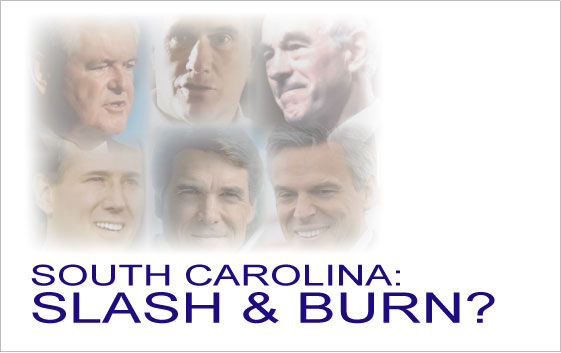
South Carolina: Slash and Burn?

Copyright © 2011 Vanguard of Freedom

A word about the politics of the South. Irrespective of the impending “slash and burn” politicking that South Carolina is famous for, there is one thing to note about the Politics of Dixie.

Because of the volatility of politics, there is at times a kind of amnesia that sets in that tends to obscure historical trends that tend to dominate the dynamics of regions, candidates, and political strategies and their outcomes.

Some actually forget because they would rather not remember the “tragedies” of the past.

But unique to the South until “recently” is the factor that the South was essentially “Democrat.” Local and state politics were dominated by a Democrat politic, versus the Republican alternative. I won’t get into the reasons for it. Suffice it to say that the South voted “Democrat” in State and Local elections and “Republican” in national elections.

A judge in Central Texas remarked to me in January of 2005 at an inauguration ceremony, lamenting that the election he had just won would be his last, because he felt he had served enough terms, wanted to give somone else a chance, and…. (wait for it)… was too old to change parties. He felt that to win in the next election he had to switch parties and run as a Republican.

The head of the county Democrat party in that region in 2005 lamented that Democrats had been changing their party affiliation, because if they wanted to win, they had to run as Republicans. There was little change to their platform, he said; however, if they expected to be elected, they had to assume the “Republican” brand, or risk being left out.

Those were the days I refer to as the early George Bush days, post 9/11. Years of negative campaigning and mega-spending by the Democrat party against George Bush and by 2008, one could still be a Republican, but one certainly did not want to be associated with the “George Bush” brand.

However, the inroads Republicans achieved into Southern politics at the state and local levels remained a significant advancement, and Republicans are no longer associated or identified as easily with the label of “Yankee pointy headed-liberals,” although that might still apply to some in the current slate of candidates.

The South held at one time that it would be “a cold day in hell” before a Democrat even considered voting for a Lincoln Republican, given the sentiments of North-South (as in “Civil War”) politics. Those were “Yellow Dog” Democrats.

To reiterate a famous Democrat quote: A Southerner would rather “vote for a yellow dog before they would vote for any Republican”.

Later emerged the “Blue Dog” era. (See this article for historical significance.)

“Moderate” Democrats could still be Democrat, but vote with Republicans in certain issues.

The 2010 backlash against Barack Obama and his politics of Socialism, bucked by the Tea Party Tidal Wave, and vindictive Democrat Party pay-back, slashed the Blue Dog “membership” in Congress by half. And If Rush Limbaugh is to be believed,  2012 will usher in another blow to the Democrat Party, this time not just in the South, but nationally as well.

But what is “tender” to Southern Republicans today is not so much the “moderate” Republican slate of candidates that has been culled by the Liberal media and served up for South Carolinians with a side of hominy grits, black-eyed peas, and collard greens. It’s the vindictive, penalizing politics of Barack Obama. It includes jobs, the economy, jobs, and the economy, and jobs.

Oh, and lest I forget: jobs and the economy!

And primarily significant is the Barack Obama Administration handling of the Gulf of Dixie B.P. Deepwater Horizon oil spill. This factor is akin to the civil war “invasion” of Dixie by the Northern Yankees. It came as a devastating blow to the South, economically on the heels of a series of hurricanes that ravaged Mississippi, Florida, Alabama, Louisiana and Texas. That the region is recovering from this does not mitigate the sting of the political effects that came from the Obama administration.

In fact, the Gulf states are recovering despite Obama politics, though Socialists might rally to take credit for any improvement. Mississippi’s recovery is in large part due to Haley Barbour and team and their efforts at making Mississippi “business friendly,” boosting employment in the rebounding furniture building industry, as well as attracting a Toyota facility in Blue Springs, and a Nissan plant in Canton, counting, of course, the resultant sub-contracting entities that provide parts, off-plant assembly, and the consequent service and product industry that results in an accelerating economy.

Louisiana economic acceleration is largely due to Governor Bobby Jindal, his Chief of Staff Tim Teeple and team, who did not sit around and wait for a federal rescue from the Gulf Spill fiasco.

Let’s also not forget the Obama Administration National Labor Relations Board’s suit against Boeing in South Carolina, which attempted to shut down the plant because it was not a Union facility.

Majorly affected by the economic tragedy of Obama-nomics in the South are Southern Blacks, who voted for Obama in 2008. Will they remain loyal to Barack Obama because of “race?” This, I believe, is a significant reason why Obama will exploit the race issue in his upcoming run for the Presidency in 2012, and indeed is already doing so, under the guise of “class warfare.” Indeed, that is his only recourse, and it should be expected and exploited by Republican campaign efforts as well, with a strategy that counters it.

In fact, this Dixie Oil Spill issue alone might see a resurgence for Rick Perry in South Carolina, unless his campaign is not savvy enough to include it.

There need not be a slash and burn Primary election battle among Republicans in South Carolina, although there may well be. But if there is any way to coalesce, if not behind a candidate, certainly then in a movement against Barack Obama. It would be a gravely and strategically missed opportunity if it were not to happen in the coming days in South Carolina.

Here can be the Obama waterloo, or at least the launch of that battle. It would add a unique Southern flavor to national political cuisine politely served with Dixie hospitality as the 2012 campaign heats up.

To paraphrase an old adage, Political revenge, in the North as in the South, as we all know, is a dish: best served cold. The colder the dose, the “better” the burn, the more effective the frost-bite.

Regardless of who is slashed and who is burned, South Carolinians next week will choose for themselves and possibly for the nation, who best will deliver that dish on November 6, 2012.

Vanguard of Freedom Network / Patriot Action Network / Liberty News Network

New Hampshire Primary Time

The New Hampshire polls close at 8:00 PM (EST) tonight and shortly there after we’ll know how the fight ends. A new Rasmussen Report poll taken Sunday shows where it could end, should the numbers hold through the evening.

Mitt Romney, the former governor of neighboring Massachusetts, remains well ahead of his nearest rival in Rasmussen Reports’ final survey of the New Hampshire Republican Primary race.

Romney earns 37% support, with Texas Congressman Ron Paul a distant second with 17% of the vote in the latest telephone survey of Likely Republican Primary Voters taken Sunday night. Former Utah Governor Jon Huntsman is now in third with 15%, up slightly from 12% late last week.

Santorum has 13% and Gingrich has 8%.

I don’t think it will surprise anyone to see Mitt Romney dominate tonight. What might be a surprise, though, is a Huntsman surge to #2. I can’t imagine a scenario where Huntsman finishes first, so isn’t it safe to assume he would charge on to South Carolina with a second place win?

We’ll be watching with live results reporting here on the blog.

-Eric Odom