Arizona and Michigan up next… what to expect

The four remaining candidates are likely spending a good deal of the day preparing for tonight’s CNN GOP debate in Mesa, Arizona. Their campaigns are likely in high gear working the phones statewide in both Arizona and Michigan. The two states suddenly became a little more important when Rick Santorum surprised the field and won the Missouri, Minnesota and Colorado nod a few weeks back. That turn of events signaled to the following states that Romney was not invincible, and in fact, was quite vulnerable.

A month ago both Arizona and Michigan were assumed to be the “cherry on top” for a decent Romney sweep through February. Sure, it wasn’t expected that Romney would perform well in Missouri, but it was definitely expected he would be very competitive in Minnesota and ultimately win Colorado. While this positioning would not provide any delegates, it would throw water on the fire of the narrative that Romney doesn’t have wide support across battleground states. Instead, Romney lost all three, adding fuel to the fire of the narrative that he can’t win a broad base of support in battleground states.

The former front-runner now finds himself in second place to Rick Santorum, looking ahead to a possible loss in Michigan, a state where he was once thought to be extremely safe. The RCP average for Michigan has Santorum up by about a point. Romney is up by 8% in Arizona.

What does it all mean?

Well, regardless of the results on Tuesday, the game will not change. What happened several weeks ago in Colorado is what changed the game. The only thing that could somewhat shake the ground is a win in Michigan for Santorum, as it would again provide an injection of much needed campaign cash and momentum. A loss in Michigan would have the opposite effect for Romney. That said, no candidate will drop out and I don’t expect that national positioning will change much until after Super Tuesday (Santorum is the front-runner by just under 6%).

Romney will go on to win the states he’s expected to win on Super Tuesday (with the exception of maybe Washington). Rick Santorum and Newt Gingrich will fight to split the others. Ron Paul will pick up delegates with various lower tier finishes.

Super Tuesday isn’t far away, though, and that’s when we find out where we really stand. As of today, Gingrich is poised to only pick up Georgia with a first place finish. He might be able to do something in Tennessee, but that would be it for his first place possibilities. Santorum looks good in Oklahoma and Ohio. Romney should easily grab Vermont, Virginia and Massachusetts. That only leaves North Dakota, Idaho and Alaska, and I have a feeling Santorum might do well in those.

In the end I think Super Tuesday probably won’t answer any big questions. It could, however, clearly establish the fact that Romney is not at all the front-runner.

-Eric Odom

Ron Paul vs Rick Santorum Ads

Two notable TV ads to show you today. The first is an ad the Santorum crew put together that displays a collection of supportive quotes from high profile conservatives and conservative entities. This is important for Santorum as a key part of his potential success on Super Tuesday will be the appearance of unifying conservatives around his candidacy. To date no candidate has successfully done this and a lot of undecided voters are still waiting to see if/when it will happen.

Of course, the quotes do not exactly translate to endorsements. Conveniently the Santorum campaign is not stumbling over itself to point that out, though.

The second ad slams Santorum across the board and comes via the Ron Paul campaign.

“Is this dude serious?” the narrator asks over a cartoon of Santorum. “Fiscal conservative, really?” The ad then runs down various spending Santorum supported while in the Senate. In the end, it compares Santorum the fiscal conservative to Bigfoot — “Fake.”

There’s a shot at Santorum’s social conservative credentials, too — the ad claims he “even hooked Planned Parenthood up with a few million bucks.”

It’s brutal…

Thoughts?

-Eric Odom

The GOP Field… where do the candidates stand in the numbers game?

What a whirlwind of a primary. I’ve had an interesting perspective in this primary since my candidate, Herman Cain, left the race because I don’t really support any of the four current candidates. I find all four have certain qualities that make them interesting possibilities, and all four have flaws that rule them out for obtaining my full personal support. So for the first time in my voting lifetime, I don’t have a dog in the fight. I’m in a curious “watch and see” mode that is proving to be highly entertaining as this thing rolls out.

Which brings us to the question… how’s this thing rolling out?

If there is anything we’ve learned about the 2012 GOP primary, it’s that it simply cannot be predicted. Well, certain parts can, but the overall picture cannot. I’ve made two big predictions in this primary. My first was that Sarah Palin would endorse Rick Perry (they were chums as Governors and Perry strongly supported her). Obviously Perry floundered and dropped out, so that didn’t happen. My second prediction was that Romney would win Florida by a landslide. That did happen. And for the exact reasons I predicted it would.

My view of what I thought would play out in February went blurry on February 7th. Yes, to be clear, the three states that held primary elections on February 7th meant nothing in terms of binding delegates. Ron Paul and Newt Gingrich fans like to constantly point that out. But in doing so they ignore the importance of perception in politics. For many voters (and by many I mean a LOT) perception is reality. Donation and word of mouth support begins taking hold based on perception. If a candidate is perceived as having a shot at coming out in front, that individual will see a significant increase in fundraising and support.

I knew Romney wouldn’t win Missouri. The state is far too conservative for his style of politics and it outright rejected Romney in every single county. Where I got thrown off is Minnesota and Colorado.

Minnesota should have at least been competitive for Romney. During the Florida primary Minnesota looked decent for a Romney win or very strong second. Former Minnesota Governor Tim Pawlenty was working the Romney brand and the Romney campaign was financially positioned to be well organized. In the end Mitt Romney pulled 17% of the vote for a distant third place finish. And I mean very distant. It would be an understatement to say Romney wasn’t competitive in Minnesota. The accurate statement would be that he didn’t even compete.

Colorado should have been safe territory for Romney. Mitt Romney dominated Colorado back in 2008 and should have walked away with an easy win. Instead, Romney lost to Santorum in a stunning last minute shift in some rural Colorado counties. My best guess for this is the Romney camp took Colorado for granted. They knew there were no delegates up for grabs and figured they were well positioned for a win there that would have dislodged any energy gained elsewhere.

The Colorado loss was a devastating miscalculation. Which brings us to the current scenario and possibilities as to how the rest of February might play out.

First, let’s look at the national polling trend.

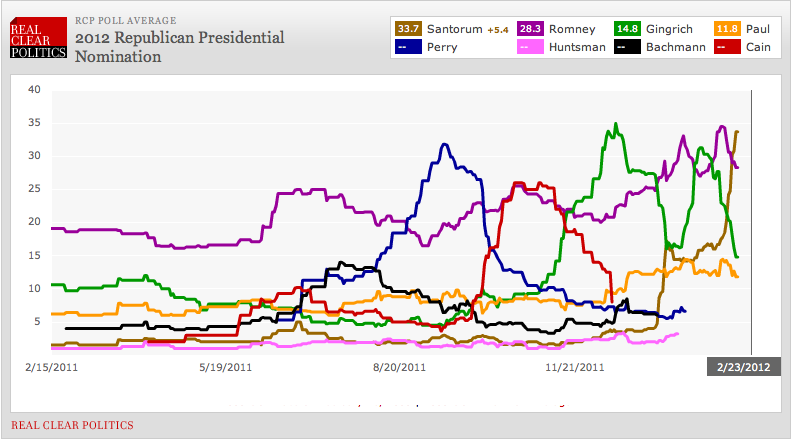
Rick Santorum now finds himself as the national front-runner with a 5.4% advantage over Mitt Romney. Newt Gingrich is at his lowest average since mid-November, coming in with just under 15%. Ron Paul sits at the usual 12%.

On February 28th we’ll see primary elections in Michigan and Arizona. Mitt Romney was expected to win both, but is now slipping to a second place position in the trends in Michigan. He still holds well in Arizona, which is important for his campaign since Arizona is a winner-takes all state on the delegates. If Rick Santorum wins Michigan and Mitt Romney wins Arizona, Romney would be ahead in terms of binding delegates, but both would have a 50/50 shot at the nomination.

On Super Tuesday Mitt Romney is likely to take Massachusetts, Vermont and Virginia. Newt Gingrich will get a big delegate boost out of Georgia (although his lead in Georgia slipped from 53% in December to just 9% now). Rick Santorum is positioned well in Ohio, but Romney’s media machine could very well change that. Santorum will compete with Gingrich for Tennessee, Oklahoma, Idaho and Alaska.

In other words, in a situation where Romney’s camp would have liked to have the deal sealed by Super Tuesday at the latest, we might find ourselves exactly where we are now, a day after Super Tuesday. A tied up front-runner spot with Romney struggling to stay out front.

In all honesty, I don’t see how Romney wins the primary if Gingrich or Santorum drop out. More so if Gingrich drops out, as Santorum appears to be a more acceptable candidate for general consensus within conservative ranks.

But again, anything can happen and there is no way to predict this. I guess the most important take-away here is that Romney is no longer the clear front-runner and may end up losing the primary yet again. Four weeks ago that didn’t at all seem possible.

-Eric Odom


Rick Santorum’s home run

If Mitt Romney’s campaign plan involved sweeping February and having the deal sealed on Super Tuesday, his advisors are likely frantically switching to plan B right now. And if Rick Santorum was hoping for a good shot at a successful hail marry pass, he’s now got it.

Rick Santorum dominated Missouri, took a commanding lead in Minnesota and ended up outgunning Romney in his own territory in Colorado. The night was flawless for Rick Santorum and an absolute nightmare for two other candidates. Let’s walk through the nightmares and then we’ll circle back to Rick Santorum.

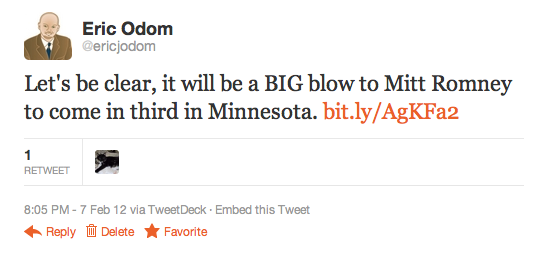
The above image is a tweet I sent out at 8:05 PM last night. At the time my thinking was that early reports showed a possibly damning result for Mitt Romney in Minnesota. This vibe began to strengthen not long after when both Ron Paul and Rick Santorum were beating Romney in counties surrounding the St Paul and Minneapolis area. At the same time, the counties around St Louis and Kansas City were going strong for Rick Santorum as well. We knew Romney wasn’t likely to do well outside of the major metro areas, but we had no idea he would fall in the cities as well.

But if that were the worst news of the night for Romney it would have been much better than what ended up happening in Colorado. Earlier I mentioned Colorado as Romney territory. I say that because in 2008 Romney dominated Colorado, blowing out McCain and Huckabee by a huge margin. Unlike Minnesota and Missouri, Romney had significant infrastructure and organization in place across Colorado. The fact that Romney lost Colorado is wildly damaging to the narrative that Romney can win big battleground states.

Additionally, while I can’t get into the minds of Romney’s advisors, my guess is Colorado is the first state they thought they would win, but lost. I mean, the polling indicated a loss in South Carolina and the Romney team downplayed expectations going into the southern conservative state. But Colorado… all indications were that Romney would walk away with it with no problems.

I honestly believe there might have been a serious miscalculation happening on the part of the Romney team last night. I think that since they knew all three states had non-binding delegates, they decided not to spend big money in Missouri and Minnesota. They assumed they would likely win Colorado, and while they spent significant money there, they didn’t pile on to seal the deal in a big way. As a result, they ended up getting trounced in all three.

The size of the contrast between Romney losing two states and three last night simply can’t be overstated. February was supposed to be his month. It was a time for him to trump the field and show he can carry a diverse range of states going into Super Tuesday. Two weeks ago he was looking decent in Minnesota, strong in Colorado and somewhat competitive in Missouri. Today he looks like a very weak, barely front runner.

You know who got hurt worse than Romney last night? Newt Gingrich.

The second candidate to go through a nightmare scenario last night is Newt Gingrich. It’s true the Gingrich failures didn’t get as much attention as Romney’s, but the long term effect will be far more damaging for Gingrich than it will for Romney.

First, Gingrich was nothing short of an afterthought in all three states, even though his choice to forgo the ballot only occurred in Missouri. How Gingrich finished dead last in Minnesota is beyond me. He didn’t do a whole lot better in Colorado, coming in a very distant third.

Second, Gingrich has openly admitted he needs Santorum out of the race in order for him to see victory. Gingrich has gone so far as to actually call for Santorum to drop out. Now, instead of Gingrich enjoying the possibility of splitting all the Super Tuesday states with Romney, he’ll be lucky to split half of them with Rick Santorum.

Which brings me back to Santorum… can he win?

Santorum is now a very legitimate candidate and he’ll likely get a couple million dollar strong boost to his campaign by the end of the week. I don’t think his chances are great in any of the states between now and Super Tuesday, so he would be wise to focus his energy on those states. If Santorum can do well in the debate planned for later this month, raise a ton of cash and continue to unify conservatives around the idea he can win as the Not-Romney candidate, he can possibly elbow Gingrich out for a better chunk of the Super Tuesday delegates.

But just as Santorum is a hurdle for Gingrich, Gingrich returns the favor by being a major hurdle for Santorum. Both candidates will be very competitive for the conservative vote in southern primary battles that begin happening on Super Tuesday and beyond.

With all four candidates in the race, Mitt Romney is still the front-runner and likely nominee. But if Santorum continues to gain momentum and Gingrich continues to have days like yesterday, we might have ourselves a serious fight to the finish.

-Eric Odom

Delegate roadmap gets tough without a Florida win

JACKSONVILLE, FL - JANUARY 26:  Republican pre...

Image by Getty Images via @daylife

The importance of Florida in the GOP primary can’t possible be expressed in words. The reason has less to do with the number of delegates available and more to do with the five weeks that follow. Well, I guess depending on who wins Florida the numbers prove critical, but it’s the next five weeks that will set up the next big phase of the primary.

Here is where we are on delegates so far (this is an estimate and could slightly change).

  1. Newt Gingrich – 23
  2. Mitt Romney – 19
  3. Rick Santorum – 13
  4. Ron Paul – 3
  5. Jon Huntsman – 2

Florida is a winner-takes-all scenario with 50 delegates. Next up will be Nevada with 28 delegates and Maine with 24. If Romney wins Florida, I would feel safe betting on a win for him in both Nevada and Maine. If Gingrich wins Florida, he’ll quickly become very competitive in Nevada. In fact, I think if Gingrich wins Florida he would very well win Nevada as well. That’s a BIG if, though as it appears to be heading in the direction of a big win for Romney.

After Nevada and Maine comes Colorado and Minnesota. Tim Pawlenty is swinging hard for Romney and I don’t see Gingrich gaining much traction in Minnesota. Colorado went Romney last time around but will be the state Gingrich and/or Santorum might be able to make another stand. Keep in mind, though, Colorado is the only state I see Romney having to really fight for if he wins Florida.

Then you have Arizona, Michigan and Washington. I suppose Arizona could be a bitter fight as it’s a pretty conservative state. I also believe that John McCain will open up his AZ campaign infrastructure for the benefit of Romney and it will be a tough fight. Washington and Michigan are likely going to be Romney territory.

Then, we’re into Super Tuesday. If Gingrich can afford to stay organized and strong this far, he’ll be able to do some catch up in Georgie, Tennessee and Oklahoma. The problem here is Romney will be able to counter any success with wins in Virginia (Gingrich and Santorum failed to make the ballot), Vermont and Massachusetts. Ohio is questionable, but I would imagine it might go to Romney if the momentum is in his favor.

Granted, most of these states are now proportional on the delegate front. But that would only benefit second place if they were only proportional two ways. In this case you will likely still see Ron Paul scrapping for delegates and Santorum may still be int he hunt as well. In most cases the delegates are proportional unless a candidates gets 50% or

more of the vote. Not-Romney candidates would have to fight hard to keep Romney from getting 50% in any states to keep him from running the map on delegates.

Like I said, if Gingrich can pull off a win in Florida, followed by one in Nevada, he would be financially and organizationally competitive in states like Colorado and Arizona. Remember, Gingrich is up against the challenge of being able to last/compete until Super Tuesday. After Super Tuesday bigger southern states begin to hold primaries and Gingrich will do well in those battles.

But all of that hinges on Florida.

-Eric Odom